
Last Updated on February 4, 2026 by UDC Sports
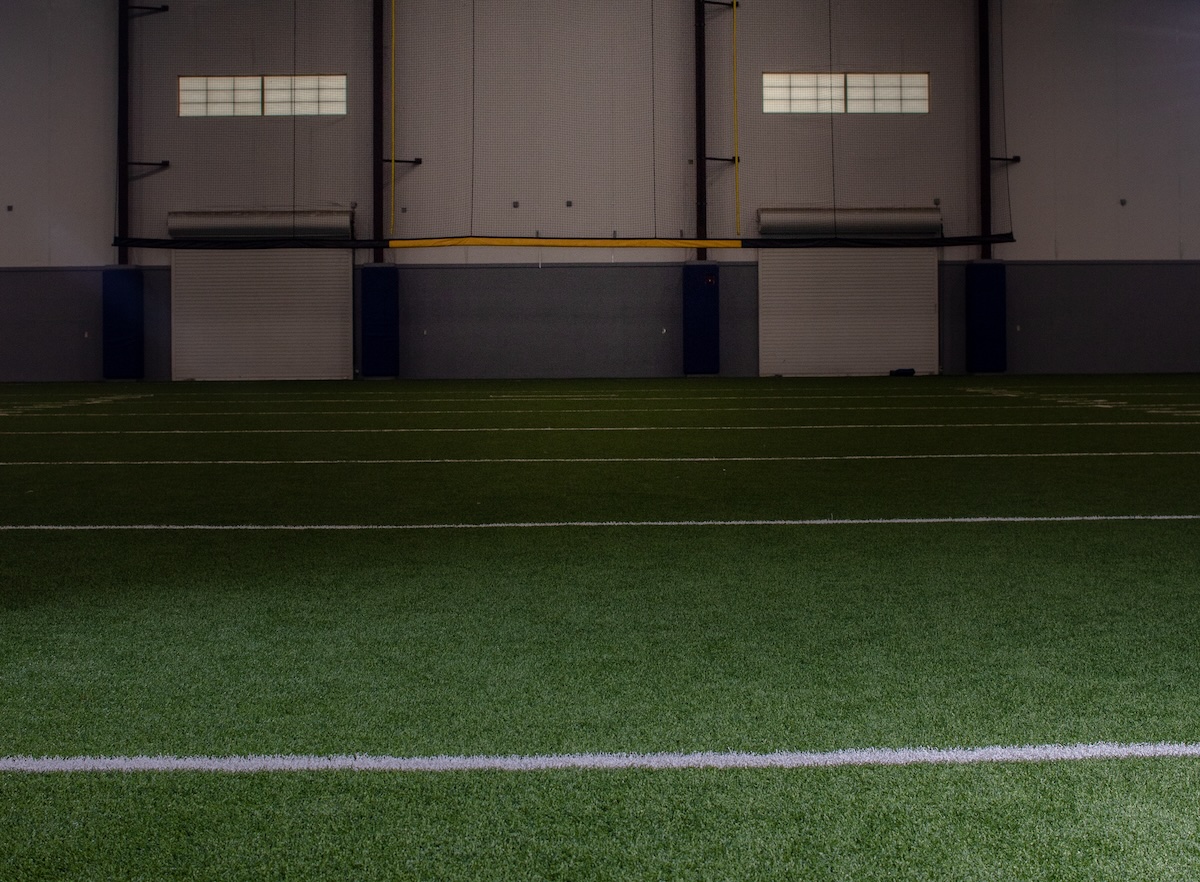
For many indoor and outdoor sports and training facilities, a properly-designed and compacted stone base can support athletic performance, while avoiding several long-term constraints that may come with a concrete slab. This is true for everything from baseball training facilities to indoor turf fields, sprint lanes, and even multi-use athletic facilities where movement, moisture, and adaptability matter more than structural rigidity.
Because of that, one of the most common (and costly) decisions made early in these projects is whether you need concrete under turf for a sports facility. In many cases, slabs are specified by default before performance goals, drainage behavior, or the possibility for future facility changes are fully considered. But once concrete is poured, that decision is effectively permanent, shaping how the surface performs, how moisture is handled, and how expensive it will be to adapt the space down the line.
What a Stone Base Means in Sports Construction
A stone base is not loose gravel dumped and rolled flat. In athletic applications, it’s a layered, engineered aggregate system designed to carry load, manage moisture, and stay stable over time.
A typical sports-ready stone base includes:
- A prepared subgrade, evaluated and compacted for uniform support
- Geotextile fabric where needed to separate soils and prevent migration
- Multiple lifts of graded aggregate, compacted to specification
- Final laser grading to achieve tight tolerances for sports turf installation
When properly designed and built, this base acts as a unified, stable platform: it holds grade, meets turf flatness tolerances, stays permeable, and can be serviced over time. Of course, like any engineered base, performance still depends on subgrade conditions, confinement, compaction, and drainage details—if those are wrong, issues usually show up gradually as settlement, soft spots, or surface irregularities rather than “all at once” failure.
Benefits of an Aggregate Base vs Concrete
1. Load-Bearing Without the Rigidity
TL;DR:
In many sports and training facilities, concrete gets poured before turf is installed, when it is unnecessary for the project. A properly-engineered crushed stone/aggregate base can support athletic use while offering better drainage, lower upfront cost, and far more flexibility if the facility ever needs to change. Once concrete is in, it’s permanent and expensive to undo. For most athletic environments, a stone base reduces long-term risk by keeping future options open without sacrificing performance.
One of the most common reasons concrete gets specified is concern about load. People picture athletes, sleds, cages, portable mounds, and equipment concentrated in one space and assume a base of crushed stone can’t support it. But in practice, a properly designed and compacted aggregate base distributes load very effectively.
In a confined aggregate system, applied loads spread laterally and downward through the stone matrix as contact forces move between particles. Concrete also distributes load—but it does so differently, through rigid plate action. The key difference isn’t whether load spreads, but how stiff the system is and how it responds to repeated, dynamic loading. Aggregate bases are used beneath highways, runways, and other heavy civil infrastructure. This is because they help distribute load over depth, manage moisture, and protect the subgrade.
For most sports facilities and athletic training environments, the limiting factor isn’t compressive strength. It’s uniformity and consistency. A stone base that’s properly graded, compacted, and confined behaves predictably under repeated use.
Concrete Behavior
Concrete is a continuous, rigid plane. It deforms very little under load, which is part of what makes it structurally reliable—but also what makes it feel “hard.” When force is applied, the slab responds the same way every time. There’s minimal internal movement, and relatively little energy is dissipated within the material itself. That stiffness is why concrete feels unforgiving compared to layered systems, even when both are technically “strong.”
Stone works differently because it isn’t monolithic. It’s a granular system made of thousands of individual particles locked together by friction, confinement, and compaction. When force enters a stone base, it doesn’t encounter a single rigid surface. It encounters a network.
Each stone contacts multiple neighboring stones. Those contact points form angled load paths rather than a single vertical path. When load is applied, the stones don’t compress like foam, but they do engage more tightly with one another. The force spreads outward as it moves downward through the aggregate matrix, rather than being carried almost entirely by a single rigid plane.
Think of it like a crowd of people. If one person in the middle is pushed, the movement ripples outward through shoulders, hips, and feet. No single person absorbs all the force. The group redistributes it.
That load spreading is why compacted aggregate can support very high loads when properly confined and supported by a stable subgrade. The stones aren’t “strong” because they resist compression individually. They’re strong because the load footprint increases with depth, reducing stress on the subgrade below.
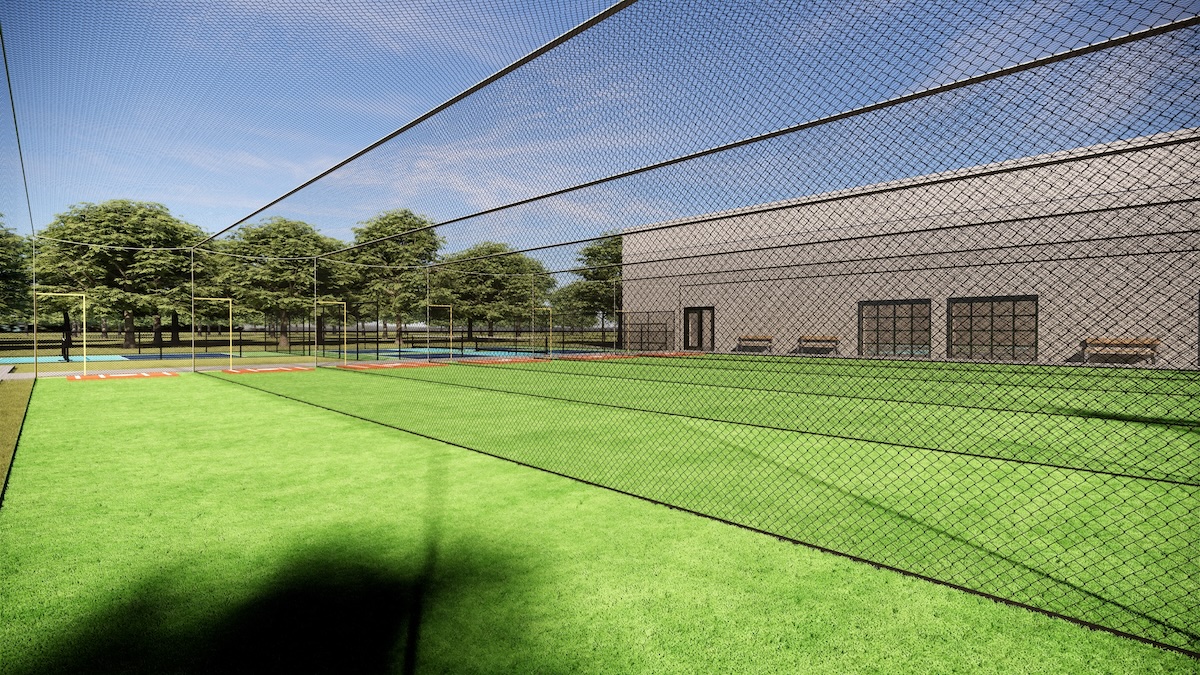
Concrete distributes load as well, but in a different way. A slab transfers load through bending and plate action, which can spread force effectively if thickness, reinforcement, joints, and support conditions are right. That approach works extremely well for buildings, columns, and fixed or wheeled loads. It’s less forgiving in environments dominated by repetitive, high-frequency, human-generated impacts.
Now add repetition.
Athletic movement isn’t a single load event. It’s thousands of cycles. Sprinting, cutting, jumping, sled pushes, landings. With concrete, the structural response doesn’t change from one cycle to the next. The slab remains rigid, and impact response depends heavily on what’s installed above it.
With stone, the system doesn’t visibly deform or feel soft, but microscopically the contact stresses between particles shift and redistribute. Small amounts of frictional movement occur at contact points. That process dissipates some energy internally within the base rather than passing all of it back upward through the surface system.
These same principles are why pavement systems—whether surfaced with asphalt or concrete—rely on layered aggregate bases beneath them. Runways and highways may use flexible or rigid surfaces, but both depend on aggregate layers to distribute load, manage moisture, and protect the subgrade under large, repetitive loads. Sports field turf installation benefits from the same layered approach. Turf fibers, infill, shock pads, and backing layers are designed to work as a system, and the base beneath them influences how force is managed.
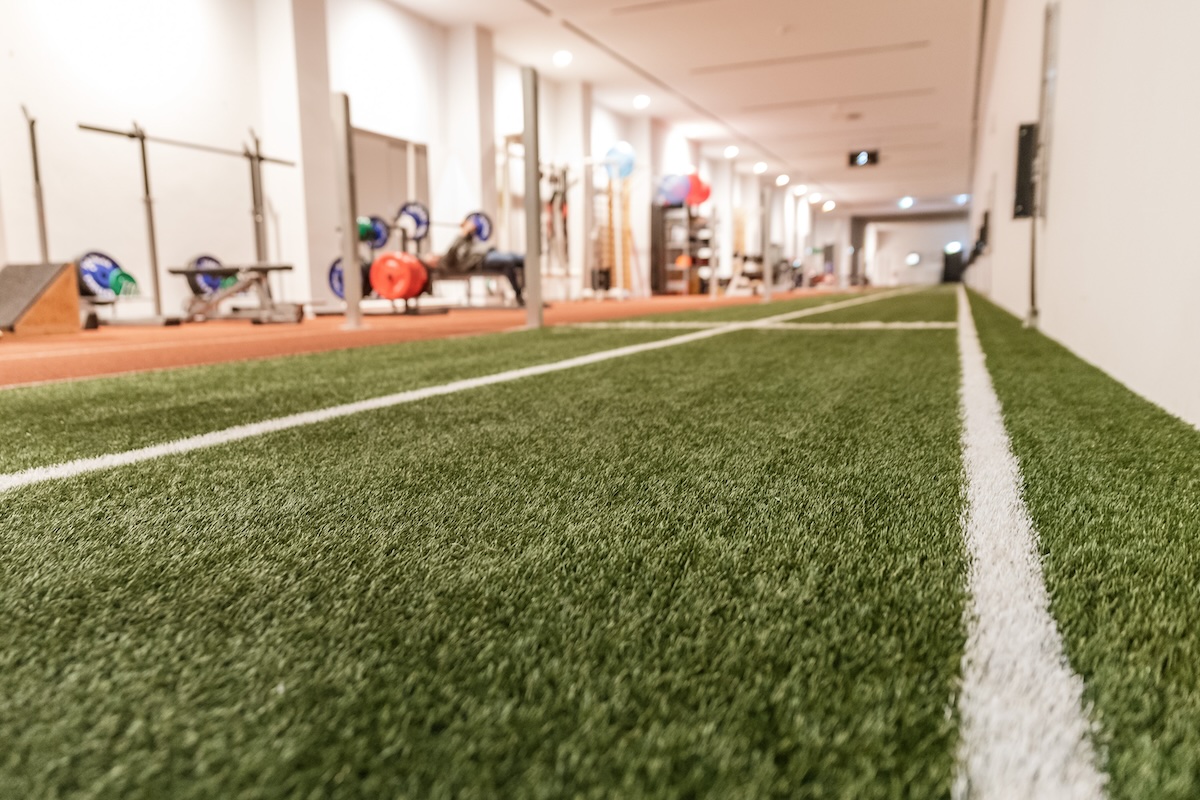
When turf is installed over concrete, impact response and drainage depend heavily on the layers above the slab. When installed over stone, the base itself participates in load distribution and moisture management.
Sports surfaces are dynamic systems. Every foot strike, cut, and landing sends force downward and back up through the body.
Concrete is stiff and consistent. Aggregate is granular and adaptive.
That difference matters in training environments where athletes repeat the same movements day after day. A stone base can work in concert with shock pads and turf backing to help manage impact and can also reduce cumulative joint stress—effects that aren’t dramatic in a single session, but become meaningful over months and years of use.
2. Drainage
Moisture is unavoidable in athletic facilities. Outdoor fields deal with rainfall and groundwater. Indoor spaces deal with cleaning, humidity, spills, and condensation.
A stone base can be designed as a free-draining layer that lets water pass through the turf system, move into the aggregate, and then flow to planned collection and discharge points (often via underdrains or daylighted outlets). It’s generally more forgiving than an impermeable slab, but it still depends on correct elevations, proper drainage routing, and an actual path for water to leave the system.
Concrete stops vertical drainage, so any water that reaches the surface system has to be managed laterally with slopes, drainage mats, perimeter drains, and detailing at transitions. If those details are undersized, poorly installed, or not maintained, moisture can linger and contribute to odor, adhesive issues, seam stress, or inconsistent surface behavior—problems that often trace back to the drainage strategy below the turf, not the turf product itself.
Over time, trapped moisture tends to show up as odor, adhesive breakdown, seam stress, or uneven surface behavior. Those issues rarely trace back to turf selection. They trace back to what’s underneath.
3. Flexibility for Future Changes
Training facilities evolve. Layouts change. Equipment gets upgraded. New technology gets added. A stone base keeps those options open.
Trenching for conduit, adjusting grades, adding new underlayment systems, or modifying drainage can all be done without demolition. The base can be reworked locally and restored without tearing out an entire surface.
Once turf is installed over concrete, those same changes become invasive. Any mistake or upgrade often means removing turf, addressing the slab, and reinstalling—at significant cost and downtime.
Stone bases allow facilities to adapt without locking themselves into a single configuration.
4. Cost
Concrete-pouring costs can add up quickly in large facilities, but the installed price varies a lot by region and specification (e.g. thickness, reinforcement, vapor barrier, finishing, access, jointing, and schedule). For example, at a rough $6 per square foot, even a mid-sized training facility can spend tens of thousands of dollars on a slab before any performance layers are installed.
Redirecting that budget allows facilities to invest more in:
- Higher-grade artificial turf systems
- Shock pads tuned to the training environment
- Better lighting, netting, or training infrastructure
- Technology that directly supports athlete development
Indoor vs. Outdoor Applications
Stone bases perform well in both indoor and outdoor environments, but the reasoning shifts slightly depending on the setting.
Outdoor facilities benefit from stone because it supports natural drainage and works with surrounding soil conditions. Permanent structures like dugouts or bleachers can still be founded independently on footings without requiring a slab beneath the turf surface.
Indoor facilities often default to concrete simply because the space feels “finished.” In many steel-frame or pre-engineered buildings, the structure can be supported by perimeter foundations, grade beams, and column footings rather than by a continuous slab under the entire interior.
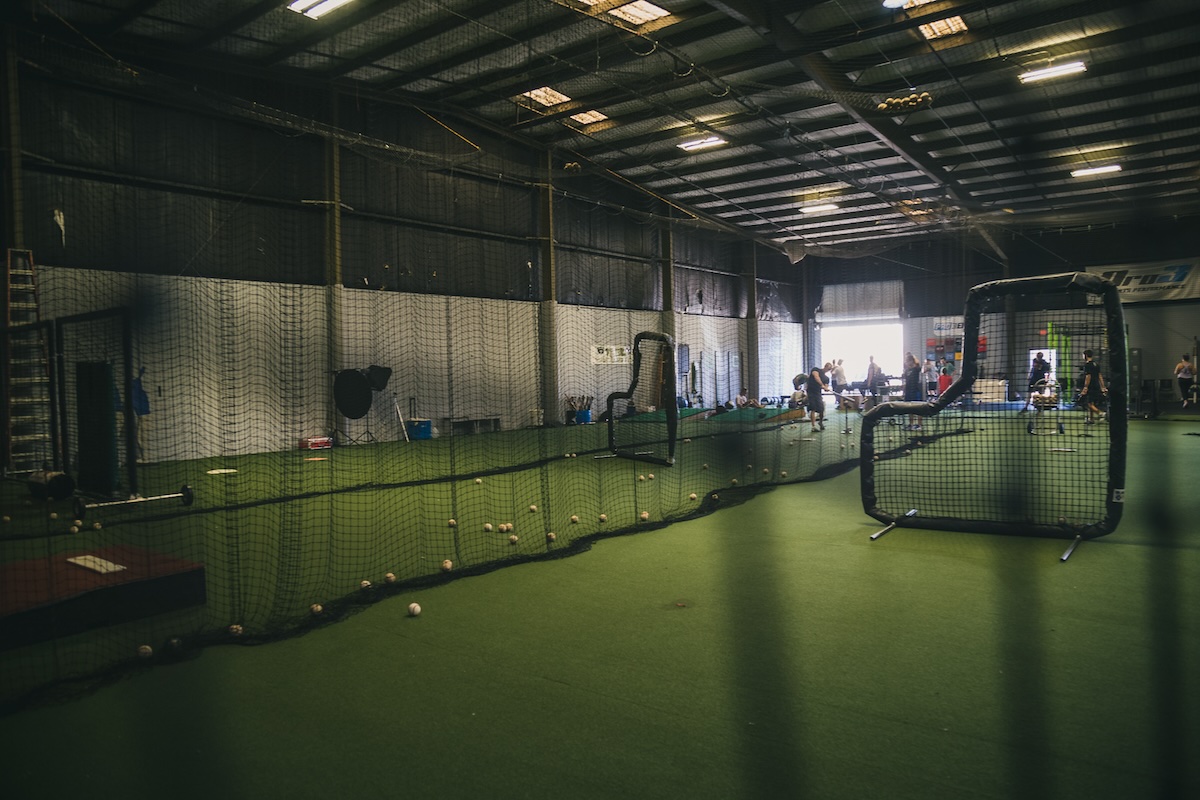 When a stone base is used under turf, the building is still constructed normally. Concrete is poured where it’s needed for structural support, door thresholds, equipment pads, and non-turf areas. The turf zone itself is treated like an engineered surface system rather than a finished floor. The subgrade is prepared and compacted, aggregate is placed and compacted in lifts, and the base is laser-graded to tight tolerances. Perimeter curbs or grade beams contain the stone so it behaves as a locked-in system.
Once the turf system is installed, the facility appears fully built out. (e.g. There’s no exposed soil, visible gaps, or other sense that anything is “unfinished.”) Transitions to adjacent slab areas are handled with standard detailing so surfaces sit flush.
One situation where this approach may not make sense is when heavy rolling equipment is present. If forklifts, scissor lifts, or palletized loads are part of daily operations, a slab or dedicated concrete lanes are usually justified. But in many training environments with sleds, racks, cages, and foot traffic, a properly-constructed stone base can provide the support needed while providing better drainage/moisture management, and keeping future modifications possible without demolition.
Takeaways
For many sports and training facilities, a properly engineered stone base can provide reliable support, a workable drainage strategy, and a surface platform that’s serviceable and easier to modify over time. Depending on the turf build-up, it may also help achieve the impact and play characteristics you’re targeting. The main advantages are permeability, reworkability, and avoiding locking the entire turf area into a rigid slab.
Concrete still has its place. Heavy equipment use, hybrid industrial spaces, and turf systems designed for slab installations can justify it. But those cases are the exception rather than the baseline.
It’s a good idea to make the decision between crushed stone and concrete early, with input from engineers, turf specialists, and sports facility contractors who understand these systems.

