
Last Updated on February 3, 2026 by UDC Sports
Important Note
This article is intended to provide general information and context. It should not be interpreted as design guidance or a substitute for consultation with a licensed engineer, architect, turf specialist, or other qualified professionals involved in your specific project. Final decisions should always be made based on site conditions, project goals, and input from the full design and construction team.
Concrete is often included in sports facility plans by default. It’s familiar, reliable, and for many design teams, it feels like a safe foundation to build from. Specs get carried forward, budgets are structured around it, and it becomes part of the plan. But is it actually necessary?
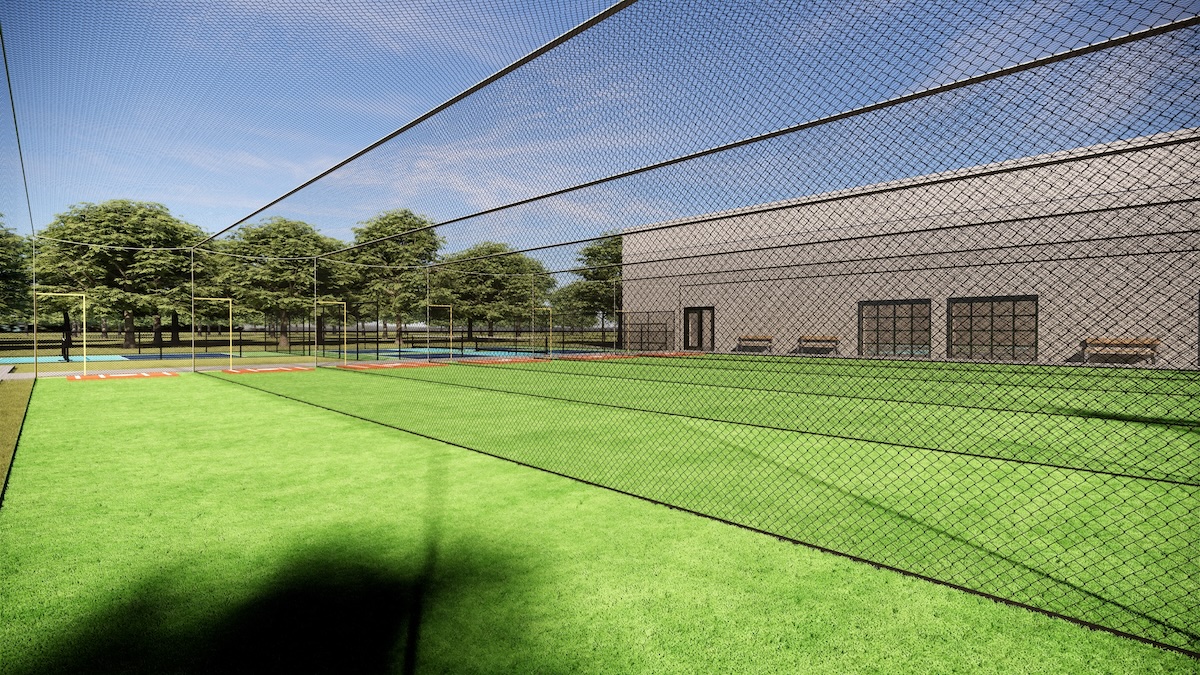
This happens often with baseball training facilities, both indoor and outdoor. But in many types of athletic facilities—training, indoor turf fields, sprint lanes, multi-use sports facilities—a well-built, properly engineered stone base can provide the same performance benefits. Stability, drainage, longevity—it’s all achievable without a slab, and often with greater flexibility.
A well-designed & constructed stone (aggregate) base is sufficient for the vast majority of synthetic turf installations, including most sports & training facility projects.
Why Concrete Is Sometimes Poured Beneath Artificial Turf
Concrete often shows up early in the planning process for good reason. For architects, general contractors, and project teams trying to make sound, reliable decisions, concrete is a known quantity. It’s flat, durable, and easy to spec. In many cases, it’s carried over from previous builds, because it’s solved similar challenges in other environments. Concrete makes sense in a lot of standard construction contexts. But sports facilities often have different demands.
In sports surface installation, artificial turf doesn’t perform like finished flooring. It’s designed to interact with dynamic movement, force, and moisture. And a concrete sublayer changes how that system functions.
When concrete is placed beneath turf without adapting the rest of the system around it, you’re introducing a rigid, non-permeable layer into what is otherwise meant to be a dynamic, breathable surface. That doesn’t make it wrong 100% of the time—but it does mean that the decision to pour concrete beneath turf should be an intentional one. Often, there are alternatives that perform better for the demands of athletic facilities.
What a Stone Base Can Provide
When designed and installed with athletic performance in mind, compacted aggregate systems offer real benefits:
Vertical drainage that manages moisture efficiently. Water needs somewhere to go. A layered stone base allows moisture to move down and out of the system rather than getting trapped beneath the turf. That helps reduce odor, prolong turf life, and maintain consistent surface conditions—especially in high-use environments.
Stability under load for equipment, athletes, and structures. Compacted aggregate, properly graded and constructed, creates a strong, uniform platform. It supports repeated foot traffic, sled work, batting cage infrastructure, and portable equipment without shifting or settling over time.
Impact response that can help reduce joint fatigue. Unlike concrete, which reflects force back into the athlete, a stone base works in tandem with turf and underlayment to absorb and dissipate impact. That means less stress on joints, especially during repetitive movement patterns common in training spaces.
Long-term adaptability if upgrades or adjustments are needed later. Need to trench for conduit? Add a new shock pad system? Regrade a corner for new equipment? With a stone base, those changes are possible without major demolition. The system stays flexible as the facility’s needs evolve.
Indoor & Outdoor Facilities
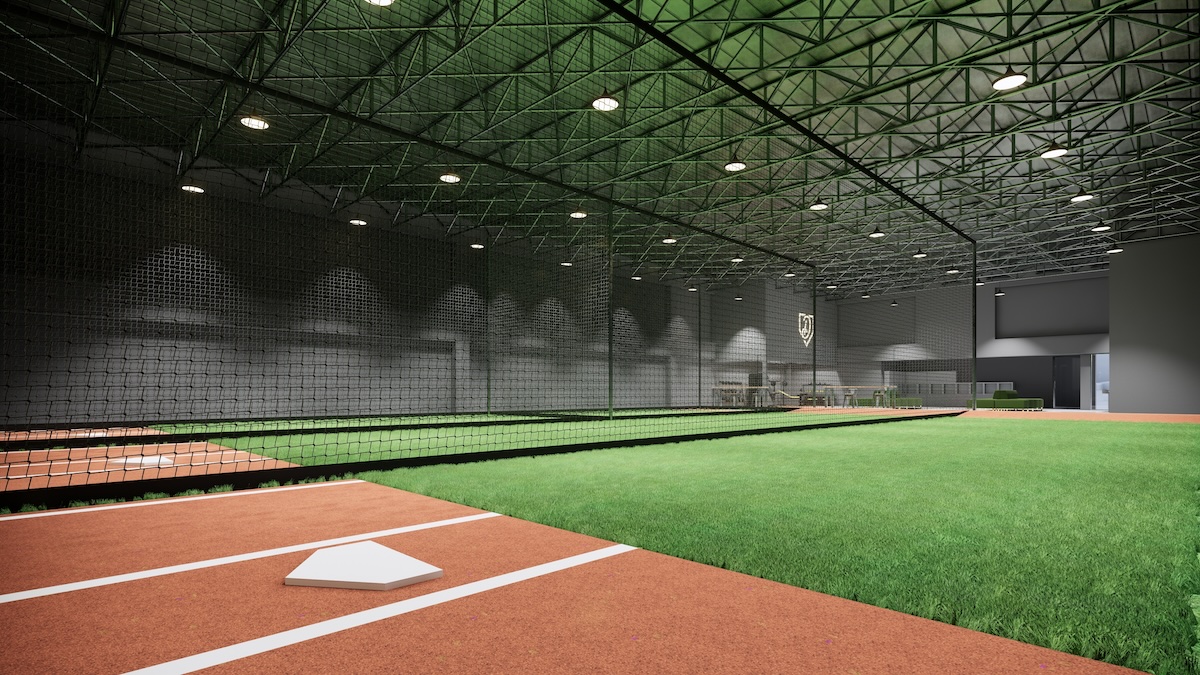
Of course, not every athletic facility lives in the same conditions, or under the same roof. What works for one space might need adjustment in another, depending on layout, usage, and environmental exposure.
Whether you’re building an open-air field or enclosing a training space inside a pre-engineered structure, the base system plays a critical part. But that role shifts slightly depending on the setting. Indoors and out, the same foundational logic applies, but how you apply it requires a closer look:
- Outdoor facilities benefit from stone bases because they support drainage and don’t require slab-level rigidity under the sports turf. Permanent structures like dugouts or bleachers can still be built on dedicated footings.
- Indoor facilities sometimes default to concrete because there’s no visible soil. But in many steel-frame or PEMB structures, the building doesn’t depend on a slab for its load path. As long as the turf area isn’t bearing heavy rolling equipment, a well-prepared stone base is still often the better choice.
Budget Considerations
Concrete pricing tends to hover around $6.00 per square foot. In a 12,000 sq. ft. facility, that’s over $70,000 before any performance layers or turf go down.
In many cases, reallocating those funds can provide:
- Higher-spec sports turf systems built for long-term use
- Underlayment or shock pad systems that support recovery and reduce injury risk
- Containment netting or infrastructure for varied training use
- Enhanced lighting or camera-based performance tech
- Greater layout flexibility over time
In short, it opens up options that serve the athletes and the facility more directly.
Drainage and Moisture Management

Concrete doesn’t drain on its own. It’s an impermeable surface, so any moisture that makes its way under the turf—whether from spills, humidity, cleaning, or even condensation—has nowhere to go.
If slope and water routing aren’t designed with precision, water can pool or get trapped beneath the surface. That trapped moisture becomes a long-term maintenance issue: it can lead to odor, promote mold or bacterial growth, break down adhesives, and stress the seams over time.
A compacted stone base is designed from the start to move moisture vertically. The material profile allows water to pass through the artificial turf system and into the aggregate layers below, where it can disperse naturally or be carried away through integrated drainage infrastructure. It’s a passive system, but an effective one—and when it’s installed with proper subgrade preparation, it quietly protects the turf from below. Managing moisture this way helps preserve the performance of the surface, reduces the risk of hidden damage, and makes the facility easier to maintain over time.
Structural Considerations
Many athletic buildings do not require a full slab to meet structural demands. Loads are often handled by perimeter footings or piers. In those situations, a slab may serve more as a finished surface than a structural necessity.
That said, it’s always worth reviewing with your structural engineer and turf partner early in the process. Every facility is different, and small details—like load requirements, moisture control, or even how equipment will move through the space—can change what makes the most sense underfoot. Getting those conversations started before the concrete is priced, drawn, or poured gives you room to make smart, performance-driven decisions.
Situations Where Concrete May Make Sense
There are legitimate use cases for concrete under turf, but they are less common than the situations where pouring concrete isn’t necessary. These include:
- Daily operation of heavy rolling equipment
- Facilities that serve both industrial and athletic purposes
- Sites where subgrade excavation is limited by existing constraints
- Turf systems engineered specifically for slab installations, with integrated drainage and adhesives
When concrete is required, whether for structural reasons, equipment loads, or manufacturer-specific turf systems, the turf assembly should be designed with that condition in mind from the start. That includes selecting appropriate adhesives, drainage strategies, and any shock or separation layers needed to protect the surface. When those elements are coordinated, turf systems can perform reliably over a slab. When they’re not, problems may show up later in the form of trapped moisture, seam stress, or premature wear.
Once turf is fully installed over a concrete slab, access to correct things like drainage missteps, adhesive failures, or trapped moisture problems is extremely limited. Any attempt to retrofit a drainage layer or address slab-related issues often means pulling up sections of turf, fixing the underlying problem, and reinstalling. This adds labor, material cost, and often disrupts facility use. If you know upfront that the system is going over concrete, the entire build-up (including drainage mats, vapor barriers, adhesives, shock pads, seam detailing, etc.) should be planned and sequenced for that condition.
The Bottom Line
 Every project is different. The right surface system depends on use, budget, performance goals, and building conditions.
For many sports training facilities, a well-built stone base is a strong, proven foundation. It delivers the necessary support, drainage, and longevity without locking the project into unnecessary costs or future limitations.
Early coordination between architects, engineers, and turf system specialists leads to better outcomes. It ensures that surface choices are made deliberately, in service of the facility’s long-term success.

