
Last Updated on August 4, 2026 by UDC Sports
Walk into almost any modern training facility, a baseball academy, a speed-and-agility gym, a CrossFit box, a college weight room, and you will find synthetic grass underfoot. Artificial turf has become the default surface for athletic training facility construction, as well as the building of performance spaces in general, because it does something concrete and rubber flooring cannot: it combines a forgiving, athletic feel with the durability to survive sled pushes, cleated footwork, dropped weights, and daily traffic, all indoors, over a properly built base, with no grass to grow or mud to track.
A Quick Note
This article offers general information and context, not design guidance or a substitute for consultation with a licensed engineer, architect, turf specialist, or other qualified professional on your specific project. Final decisions should always reflect site conditions, project goals, and input from your full design and construction team.
Installing turf in a training space is a different job from building an outdoor field, but it also differs from what many people assume it involves. There is no soil to grade the way an open field requires, and the design centers on the surface underneath, the layers built over it, the turf product suited to the training use, and how the whole system is seamed and secured. One common assumption is worth addressing up front: indoor turf does not automatically require a poured concrete slab. For many indoor training facilities, a properly engineered stone (aggregate) base performs as well or better, a point we return to in detail below.
Why Training Facilities Choose Turf Over Other Surfaces
Training and performance spaces have surfacing needs that fall between a sports field and a gym floor, and synthetic turf occupies that middle ground better than the alternatives.
- Compared to bare concrete, turf is dramatically easier on joints. Speed work, plyometrics, and repeated footwork on concrete punish knees, ankles, and hips; a turf-over-pad system absorbs a meaningful share of that impact.
- Compared to rubber gym flooring, turf offers directional traction and a natural running feel that rubber cannot, which matters for agility drills, sprint mechanics, and sport-specific movement.
- And compared to natural grass, which is a non-starter indoors, turf needs no light, no water, no fertilizer, and no growing season, staying consistent and playable every day of the year.
Turf also handles the specific abuse of a training environment well. It tolerates cleats where hardwood and rubber would suffer, provides a surface for turf-specific tools like sleds and prowlers, and defines functional zones, a sprint lane, a throwing area, a stretching zone, within a larger space. For multi-use facilities, a turf area alongside a rubber lifting platform and a court surface lets one building serve several training modes at once.
Common Indoor Turf Applications for Athletic Training Facilities
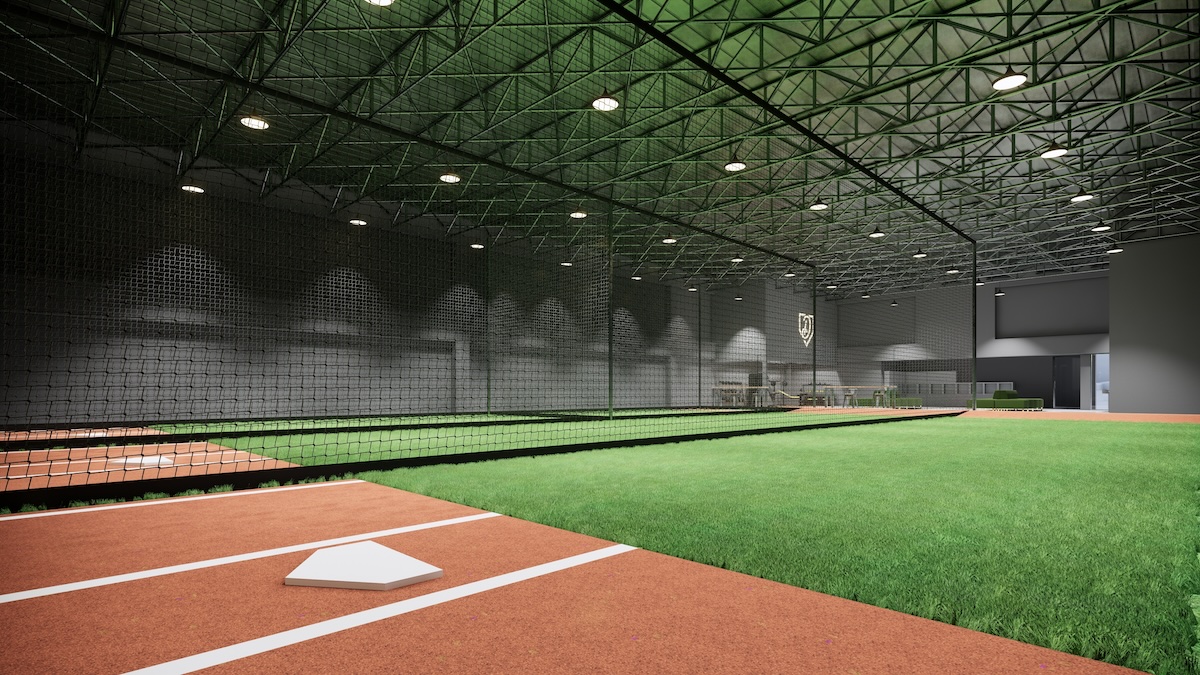
Batting cages and baseball/softball training. When it comes to baseball training facility design and construction, batting cages need turf that holds up to cleated footwork in the box, absorbs the drag of dragged feet and equipment, and drains quickly if the space is near an entrance or subject to humidity. Shorter, denser pile suited to athletic traffic tends to outperform taller landscape-style turf here.
Speed, agility, and sprint lanes. Dedicated turf lanes for sprint work, ladder drills, and change-of-direction training reward a surface with consistent traction and a predictable, uniform feel underfoot. Line markings or contrasting turf inlays can mark distances and lanes directly into the surface.
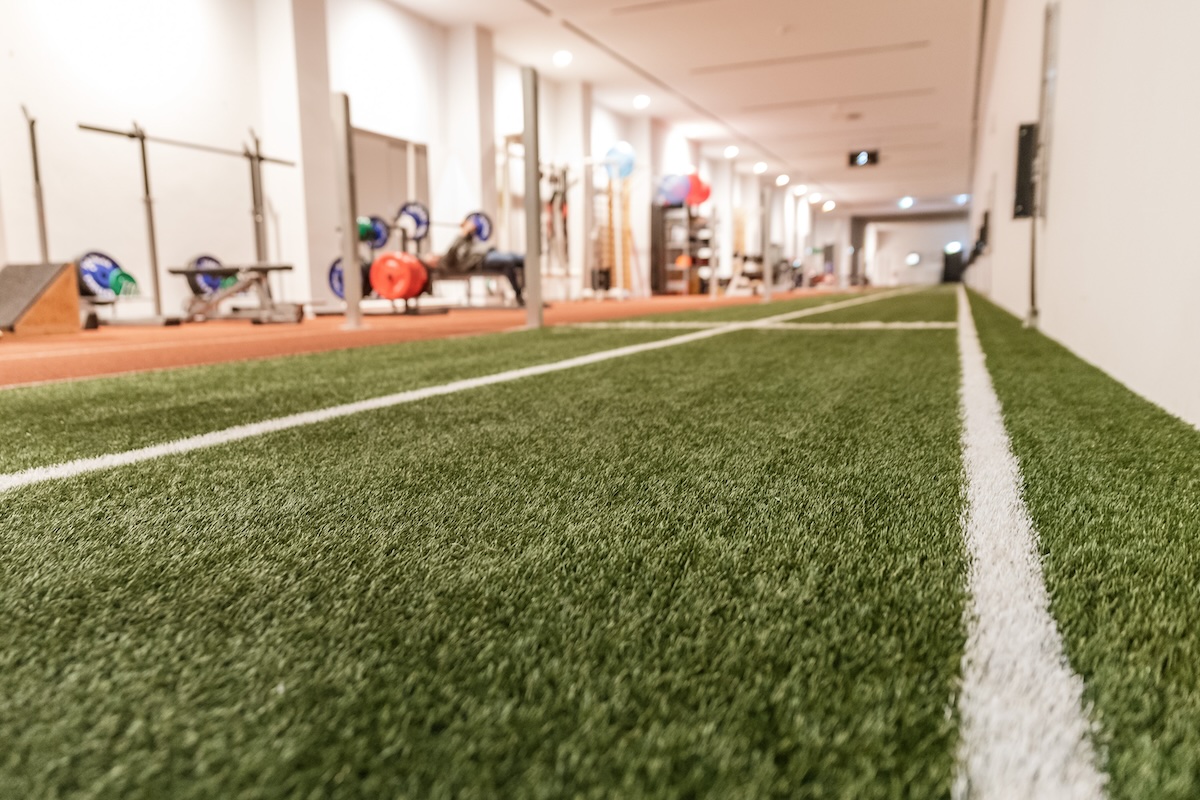
Functional fitness and gym floors. CrossFit boxes, performance gyms, and weight rooms use turf for sled tracks, tire flips, carries, and dynamic warm-ups. These spaces often pair a turf strip with a rubber lifting area, and the turf needs to withstand heavy dropped equipment along its edges.
Weight-room and team facility turf. College and high school strength programs frequently surface part of the weight room in turf to allow prowler pushes and dynamic work alongside the racks. Logos and team branding are often inlaid for these high-visibility spaces.
Garage and home gyms. Smaller-scale residential installs use turf for a sled strip or workout area in a garage or basement. These are frequently well suited to remnant or shorter-run turf pieces, since the footprint is modest and a single piece often covers the space.
What Goes Under Indoor Sports Turf
The most important decision in an indoor sports turf project is what sits beneath the turf, and it is also where the most common misconception lives. Because an indoor space has no visible soil, it’s natural to assume the turf must go over a poured concrete slab. However, in many cases, it does not.
For the majority of training facilities, a well-designed and constructed stone (aggregate) base is sufficient, and often preferable to concrete. In many steel-frame and pre-engineered metal buildings, the structure does not depend on a slab for its load path, so unless the turf area will carry heavy rolling equipment, a properly prepared stone base is frequently the better foundation. It provides vertical drainage that moves moisture down and out of the system, stable support for athletes and equipment, impact response that works with the turf and underlayment to reduce joint fatigue, and long-term adaptability if the facility later needs to trench for conduit, add a shock pad, or regrade for new equipment. We cover this question in depth in some resource articles on whether you need concrete under turf, as well as what goes under artificial turf in sports facilities.
Concrete does have legitimate uses beneath indoor sports/training facility turf, but they are less common than situations where it is not required. Concrete tends to make sense for spaces running heavy rolling equipment daily, facilities serving both industrial and athletic purposes, sites where excavation is constrained, or turf systems engineered specifically for slab installation with integrated drainage and adhesives. When concrete is the right call, the whole turf assembly, drainage mats or vapor barriers, adhesives, shock or separation layers, and seam detailing, should be planned for that condition from the start, because a rigid, non-permeable slab changes how the turf system manages moisture and impact.
Whatever the base, a cushioning layer is what gives a training surface its athletic feel. The main options for adding impact absorption:
| Layer | What it does | Typical use |
|---|---|---|
| Engineered stone base | Compacted aggregate that drains vertically, supports load, and works with turf and pad to absorb impact | The preferred base for most training facilities |
| Foam or rubber shock pad | Adds cushioning and impact absorption; improves feel and reduces joint stress, over stone or a slab | High-impact training and performance areas |
| Padded/attached-cushion turf | Turf with a built-in foam backing, combining surface and cushion in one layer | Spaces wanting a simpler single-layer system |
| Infill | Sand or rubber brushed into the fibers to add weight, stability, and cushioning | Varies by turf type and use; some indoor turf is non-infill |
The right build-up depends on the training use and the building. A batting cage may call for a firm, predictable surface, while a speed-training area or weight-room floor benefits from more impact absorption. Because a well-designed stone base drains on its own, moisture management is built into the system from below, one of the advantages that makes it the default choice for most training facilities rather than an impermeable slab.
Choosing the Right Turf for Training Use
Not all synthetic turf is built for training environments. A few product characteristics matter most when selecting turf for a performance space.
Pile height and density. Sports turf generally uses a shorter, denser pile than landscape or field turf. Shorter fibers stand up better under heavy foot traffic and dragged equipment, resist matting, and give a fast, consistent surface. Denser stitching improves durability and wear resistance in high-traffic lanes.
Fiber type and durability. Sports turf takes abuse, so fiber durability matters. Products engineered for athletic and high-traffic use hold up to cleats, sleds, and constant footwork far better than softer landscape fibers.
Infill vs. non-infill. Some indoor training turf uses infill for stability and cushioning; some is designed to run clean without it. Non-infill turf keeps the space tidier (no infill migration or tracking) and can be preferable in gyms where dropped weights would scatter infill, while infilled systems can offer more cushioning and fiber support. The choice depends on the training use and how the space is kept.
Markings and inlays. Distance lines for sled tracks, yard markers, logos, and lane lines can be inlaid into the turf during fabrication rather than painted on, giving a permanent, durable marking that suits a training facility’s specific drills.
The Indoor Turf Installation Process
Because there is no field to excavate or drainage to engineer the way an outdoor build requires, an indoor installation depends heavily on the base underneath and how well the turf bonds or anchors to it. Whether that base is an engineered stone system or a prepared hard surface shapes the early steps, but the sequence follows a consistent shape.
Prepare the base
For a stone base, the aggregate is graded and compacted to a stable, level, free-draining platform. For an existing hard surface, the slab or floor is checked for level, cracks, and moisture, then cleaned and corrected as needed. This base work determines how flat, stable, and durable the finished surface will be.
Install the shock pad or underlayment
If the turf athletic facility design calls for cushioning, the shock pad or foam underlayment is laid over the prepared base. This layer sets the feel and impact absorption of the finished surface, so it is matched to the training use.
Lay out and position the turf
The turf is rolled out, positioned, and allowed to acclimate so it relaxes and lies flat. Panels are aligned so the fiber direction runs consistently and any inlaid markings land where the layout requires.
Seam and bond the panels
Adjacent panels are joined with seaming tape and adhesive designed for turf, with fiber direction matched across seams so they blend. On a stone base the turf can be secured with nailers and edge anchoring; over a hard floor it is typically glued down, so the anchoring method is matched to the base beneath it.
Secure the perimeter and add infill if used
Edges are bonded or finished with a nailer or trim so they cannot lift or curl. If the system uses infill, it is brushed in evenly to the specified depth and the fibers are brushed upright.
Final inspection and detailing
Seams, edges, and markings are checked, the surface is groomed, and the space is readied for use. A clean final pass ensures the turf performs and looks right from day one.
Permanent vs. Portable Training Turf
Not every training-turf install is glued down for good. The right approach depends on whether the space is dedicated or shared.
A permanent installation, anchored to the base or bonded with adhesive, is the standard for dedicated training spaces. It lies flat, stays put under heavy use, and gives the cleanest, most durable result. This is the right choice for a facility where the turf area is fixed.
Portable or rollable systems suit spaces that change use, a multipurpose room that needs turf for one activity and a clear floor for another, or a facility that wants to reconfigure. These trade some of the flatness and permanence of a glued install for flexibility. For most performance facilities with a dedicated training area, a permanent install delivers the better long-term surface, while portable systems solve a specific flexibility problem when one exists.
Caring for Indoor Synthetic Turf
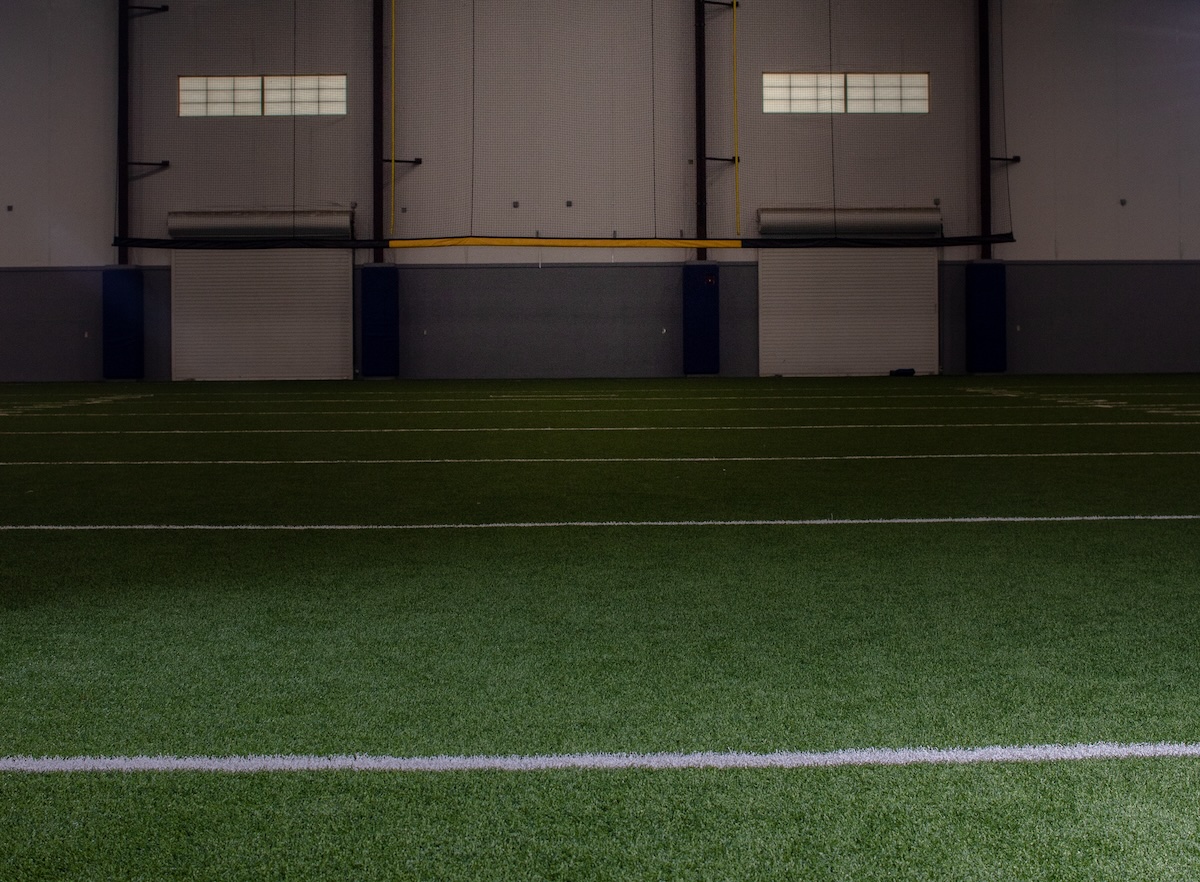
Indoor sports turf is very low-maintenance compared to an outdoor field, since there is no weather, mud, or organic debris to contend with, but it is not 100% maintenance-free.
Regular brushing keeps the fibers upright and, in infilled systems, redistributes infill that migrates in high-traffic lanes like sled tracks and sprint starts. Routine cleaning, vacuuming or spot-cleaning, handles the dust, chalk, and sweat that accumulate in a training environment, and periodic disinfection is worth building into the routine for any surface athletes train on directly.
High-traffic zones wear fastest, so keeping an eye on those areas and grooming them more often extends the surface’s life. Handled with a simple, consistent routine, a well-installed training turf surface holds its performance for years.
Frequently Asked Questions (FAQ)
Q: Do you need concrete under indoor turf?
A: Usually not. For most training facilities, a well-designed and constructed stone (aggregate) base performs as well or better than a concrete slab, and it drains, supports load, absorbs impact, and stays adaptable for future changes.
Concrete makes sense in specific cases, such as heavy daily rolling equipment, dual industrial and athletic use, constrained excavation, or turf systems engineered specifically for slabs. When concrete is used, the full turf assembly should be designed for that condition from the start. UDC covers this in detail in a separate article on whether you need concrete under turf.
Q: Can you install turf over an existing concrete slab?
A: Yes. If a slab is already in place, turf can be installed over it, typically with a shock pad or underlayment added for cushioning and with adhesives, moisture management, and seam detailing planned for that condition. The slab should be assessed for level and moisture first, since trapped moisture under an impermeable surface can stress adhesives and seams over time. Where there is no existing slab, a stone base is often the better starting point rather than pouring one.
Q: What kind of turf is best for a gym or training facility?
A: Training spaces generally use a shorter, denser pile than landscape or field turf, because short dense fibers resist matting and hold up to cleats, sleds, and heavy foot traffic. Whether it uses infill depends on the space: non-infill turf keeps a gym cleaner and avoids scatter from dropped weights, while infilled turf can add cushioning. The best choice depends on the specific training use.
Q: Do you need a shock pad under indoor turf?
A: It depends on the use. For speed work, agility training, and weight-room turf where athletes do high-impact movement, a shock pad meaningfully improves comfort and reduces joint stress over a firmer base.
For lower-impact uses like batting cages or putting surfaces, turf is sometimes installed with little or no cushioning for a firmer, faster feel. The training activity drives the decision.
Q: How is indoor turf different from an outdoor field?
A: An outdoor field is built over an engineered aggregate base designed to manage rainfall and cushioning across a large exposed surface. An indoor training space is not exposed to weather, so the system is tuned for feel, impact absorption, and durability rather than stormwater. Indoor turf can still run over a stone base, which many training facilities use, or over an existing hard floor, with the anchoring and moisture strategy matched to whichever base is present.
Q: Can turf handle sleds, cleats, and dropped weights?
A: Turf engineered for training use is built for exactly this. It tolerates cleated footwork that would damage hardwood or rubber, provides a running surface for sleds and prowlers, and holds up to the traffic of a busy facility. In weight areas, turf is often paired with a dedicated rubber platform for the heaviest lifting, with the turf handling dynamic work, carries, and sled tracks.
Q: Can I put sports turf in my garage or home gym?
A: Yes, and it is a popular use. A turf strip in a garage or basement gym provides a durable surface for sled work, agility drills, and dynamic warm-ups that is easier on the body than bare concrete. Because these spaces are small, a single piece of turf often covers the area, which can make remnant or shorter-run turf a practical, economical fit.
Indoor artificial turf turns a plain interior into a performance surface built for the demands of athletic training: forgiving underfoot, tough enough for cleats, sleds, and daily traffic, and consistent year-round. The result comes down to the details a training install lives or dies on: the right base for the building and use, the right cushioning layer, a turf product built for high-traffic performance, and clean seaming and anchoring.
UDC Sports designs and constructs sports fields and facilities, and offers high-performance sports surfaces for indoor and outdoor athletic facilities. Whether natural grass or artificial turf, court surfaces, or custom applications, UDC has you covered. To talk about your project, call 828-518-5787 or reach out to us through our contact page.

