
Last Updated on August 19, 2026 by UDC Sports
A football field looks simple from the bleachers. One hundred and twenty yards of green, a set of white lines, goalposts at either end. What sits underneath a turf football field is a piece of civil engineering: a graded subgrade, a drainage network, a compacted aggregate base, and a surface system that has to stay safe and playable through August two-a-days and November mud.
Building sports fields from scratch involves earthwork, stormwater design, permitting, precise grading tolerances, and a sequence of trades that has to run in the correct order. It sits at the intersection of two disciplines: heavy civil work below grade, and the published playing standards that govern everything above it. That combination is what makes sports construction its own specialty rather than general site work.

The sections below walk through the process from site assessment to first kickoff, aimed at schools, churches, municipalities, and athletic programs planning new construction.
Before Anything Moves: Site Assessment
Every field project begins with the ground you already have, and that ground rarely matches what a finished field requires. It isn’t flat enough. The soil underneath may not drain or bear load the way the design needs it to. Stormwater is going wherever gravity currently takes it, which is unlikely to be where a permitted design will need it to go. Site assessment is the process of establishing all of that in measurable terms before anyone commits to a design.
This is a better point in the project to find a problem than later on. A high water table, unsuitable fill from previous work, or rock at eighteen inches all change the design, and changing a design on paper can cost a fraction of what it could cost to change later, after excavation has started.
Survey and Geotechnical Work
A topographic survey establishes existing elevations, property lines, easements, and where water currently goes. A geotechnical investigation follows, with soil borings that tell the design team what the builders are constructing a sports field on: soil classification, bearing capacity, the depth to rock, and whether groundwater sits close enough to the surface to complicate things.

Heavy clay soils drain slowly and swell when wet. Sandy soils drain well but may need different compaction. Rock near the surface changes the excavation approach entirely. None of these rule out a field, though each one shapes the design, and finding out during construction rather than during design is how schedules and scopes get away from a project.
Orientation and Site Layout
Fields are traditionally oriented north to south, which keeps low-angle sun out of players’ and quarterbacks’ eyes during afternoon and evening games. Of course, site constraints don’t always allow this, and a compromise is common, though the orientation question should be settled early because it drives everything downstream: parking, spectator seating, the press box, and how the field ties into the rest of the campus.
Space around the playing surface is easy to underestimate in early planning and difficult to add later.
- Sidelines need room for teams, coaches, medical staff, and equipment.
- End zones need clearance behind them.
- Consider access for maintenance equipment, emergency vehicles, and eventual resurfacing.
Permitting and Stormwater
A new athletic field is a land disturbance, and in most jurisdictions that means a site plan review, an erosion and sediment control plan, and a stormwater management strategy. Converting an open field into a synthetic surface changes the runoff characteristics of the site, so detention or retention may be required to keep post-development discharge within permitted limits.
Permitting timelines vary considerably by locality and are one of the more common sources of schedule slip on athletic facility construction. Building review time into the front of the schedule is more productive than compressing construction at the back of it.
Field Dimensions and Governing Standards
A regulation American football field measures 120 yards from end line to end line, comprising a 100-yard field of play plus two 10-yard end zones, and 53 1/3 yards wide, which works out to 160 feet.
Where the specifications diverge is in the details, and those details depend on which body governs play.
| Element | High school (NFHS) | College (NCAA) |
|---|---|---|
| Overall dimensions | 360 ft x 160 ft | 360 ft x 160 ft |
| Hash mark placement | 53 ft 4 in from each sideline | 60 ft from each sideline |
| Goalpost upright spacing | 23 ft 4 in | 23 ft 4 in |
| Crossbar height | 10 ft | 10 ft |
Hash placement is the specification most often overlooked in early planning, and it changes the geometry of the entire field markings package. A high school field striped to college hashes will look correct to a casual observer and wrong to officials.
Confirm the governing body and the current edition of its rulebook during design. Specifications are revised periodically, and the version in effect when the field was designed may differ from the one in effect when it opens.
Planning for More Than Football
Most new fields at schools and churches host soccer, lacrosse, band practice, physical education, and community events. Each sport carries its own dimensions and markings, and a soccer pitch in particular is wider than a football field, which affects how much surface gets built beyond the football sidelines.
Deciding early which sports the field will serve determines the overall footprint, the striping plan, and whether secondary lines are inlaid into the turf or applied and removed seasonally. Retrofitting width into a completed field is not practical, so this decision belongs in design rather than in the first season of use.
Earthwork and Subgrade Preparation

This is where the field is made, and it accounts for a substantial share of the construction schedule.
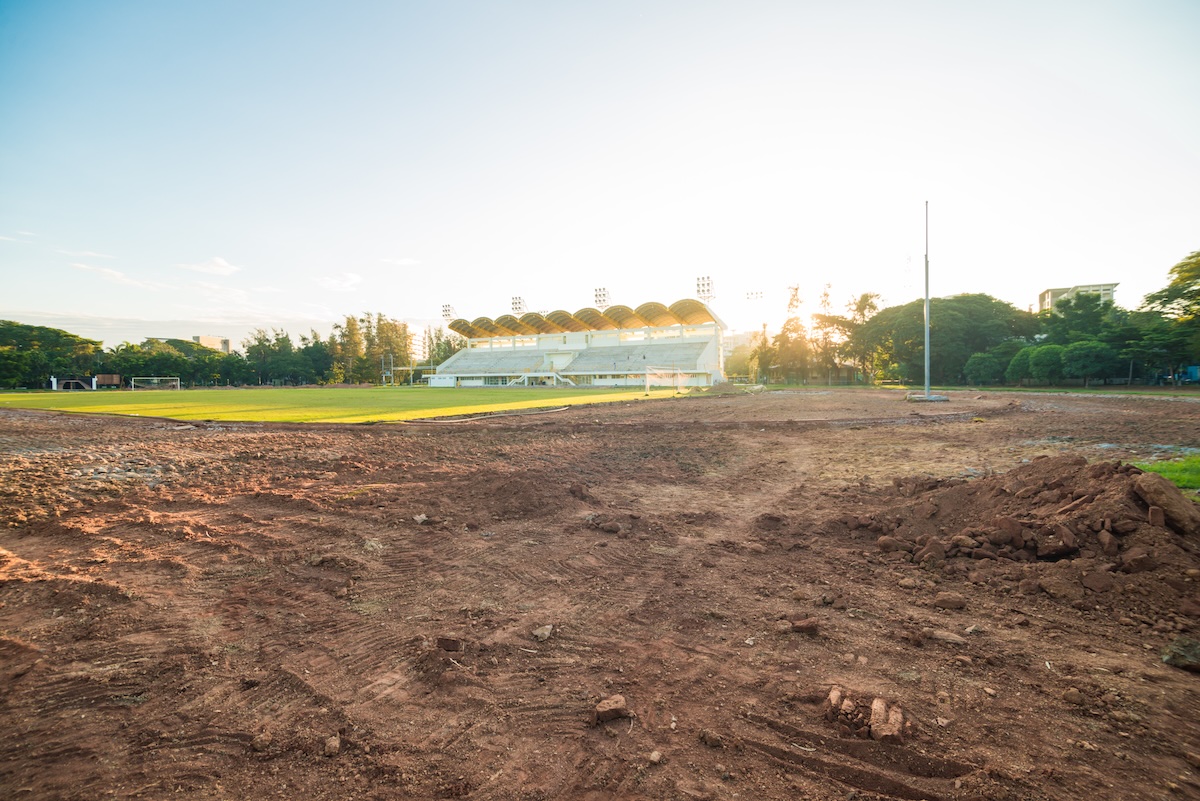
Work begins with clearing and grubbing, stripping topsoil and vegetation off the footprint. From there the site is cut and filled to bring the subgrade to design elevation. On sloped sites this can move a significant volume of material, and balancing cut against fill on site is preferable to hauling material in or off, both for schedule and for site disturbance.
The exposed subgrade is then compacted to a specified density, verified by field testing. Compaction is what keeps the finished field from settling unevenly, and settlement under a synthetic surface produces low spots that hold water and change how the ball and the players behave. Soft areas identified during proof rolling get undercut and replaced rather than covered over.
Where soils are marginal, a geotextile separation fabric is often placed between subgrade and base. It keeps fine soil particles from migrating up into the aggregate and preserves the base’s drainage function over time.
Drainage
Drainage determines whether a field is playable the morning after a storm or unusable for two days. On synthetic fields it also protects the base from saturation, which is what causes long-term instability.
Subsurface Collection
A typical synthetic field uses a network of perforated pipe laid in trenches below the base, wrapped in filter fabric and bedded in washed stone. The pattern varies with site conditions and designer preference, with herringbone and lateral configurations both common. Laterals feed collector lines, which route water to an outfall, a detention structure, or the site storm system.
Because water passes vertically through synthetic turf and its infill, then through the open-graded aggregate base, the system is designed to move water down and out rather than across the surface. That’s a different hydraulic model than a natural grass field, where much of the water sheds across a crowned surface.
Surface Slope and Crown
Natural grass fields are generally crowned, sloping from the centerline toward each sideline, to shed water across the surface. Slopes in the range of one to one and a half percent are typical, though the design depends on soil, rootzone construction, and local rainfall.
Synthetic fields with properly designed subsurface drainage need far less surface slope, and many are built nearly flat or with a slight pitch. Flatter play surfaces are preferred by athletes and coaches, and the drainage burden shifts from the surface to the system beneath it. The design slope should be established by the civil engineer based on the drainage design rather than carried over from natural grass convention.
Building the Base
The base is the structural layer between the drainage system and the playing surface, and for most synthetic turf field construction it’s built from compacted crushed aggregate rather than a concrete slab.
A stone base drains vertically, flexes slightly with seasonal ground movement, and can be repaired in sections if a problem develops. It’s typically placed in lifts, compacted, and then fine-graded to final elevation. Open-graded stone is used in the drainage layer, with a finer choker course on top to create a smooth, stable plane for the turf to lie on.
Grading tolerance at this stage is what separates a good field from an acceptable one. Base surfaces are commonly specified to a tolerance measured in fractions of an inch over a ten-foot straightedge, and laser-guided or GPS-controlled grading equipment is standard for hitting it. Any irregularity in the base telegraphs through the turf and shows up as a visible wave or a spot that holds water.
Design decisions on base construction should be made by the project’s civil engineer or geotechnical engineer for the specific site. Soil conditions, drainage design, groundwater, and intended use all factor into the specification, and no single approach suits every project.
Choosing the Playing Surface
Both natural grass and synthetic turf build good football fields. The decision usually follows from how many hours the field needs to work.
Natural Grass
Grass fields require a properly constructed rootzone, irrigation, and a maintenance program covering mowing, fertilization, aeration, overseeding, and pest management. They handle a limited number of events per week, particularly in wet weather or during winter dormancy, and recovery time between uses is part of the scheduling reality.
For programs with a single varsity team, a favorable climate, and grounds staff to maintain it, natural grass performs well and many players prefer it.
Synthetic Turf
Synthetic surfaces tolerate far more use. A single turf field can host varsity and junior varsity football, middle school games, soccer, lacrosse, band rehearsal, and physical education classes across the same week without recovery time, and it plays consistently in rain that would close a grass field.
The maintenance profile shifts rather than disappearing. Turf fields need grooming, infill redistribution, debris removal, and periodic testing, and the surface has a service life after which it’s replaced. Multi-use programs, tight scheduling, and shared facilities are what typically drive the decision toward synthetic.
Installing a Synthetic Turf System
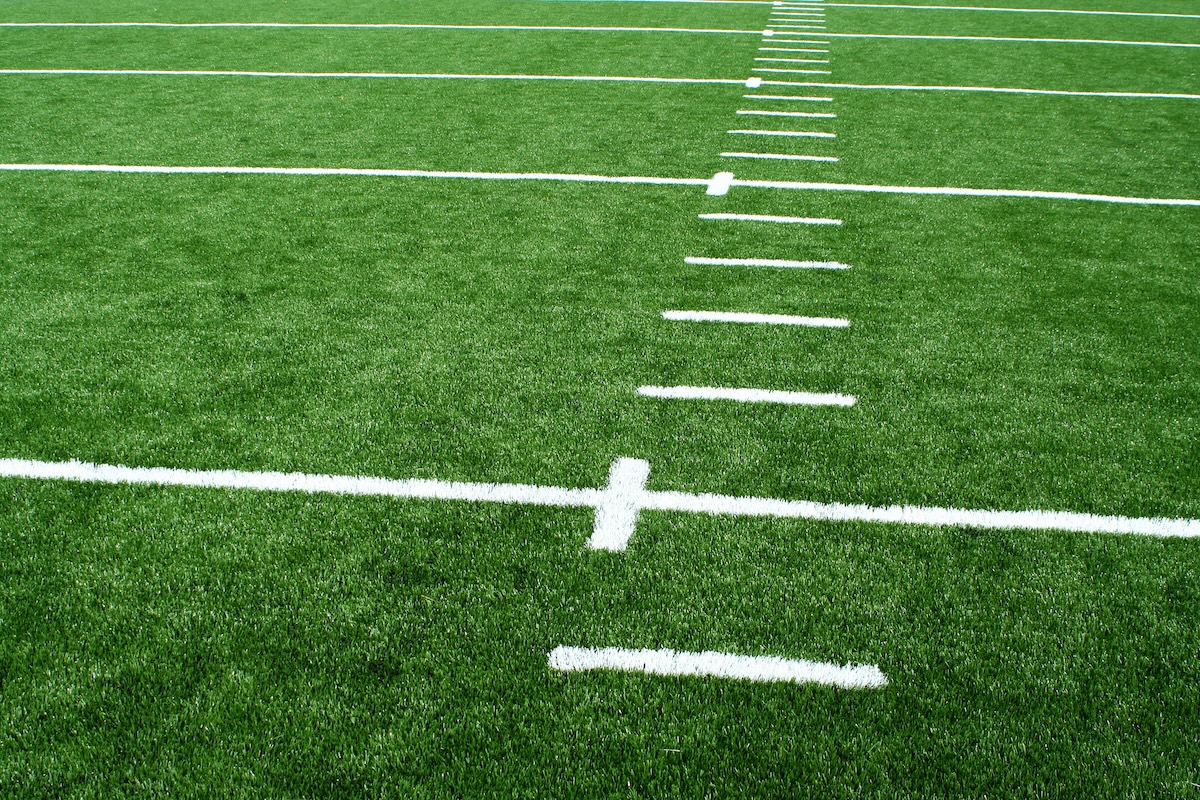
Turf installation is the visible portion of the work and among the shortest phases, provided the base underneath is right.
Shock Pad
Many systems include a shock-absorbing layer between the base and the turf, either prefabricated panels or a poured-in-place elastic layer. The pad contributes to impact attenuation and helps the field maintain safety performance as infill compacts over the years. Whether a pad is included depends on the specified system and the performance targets for the field.
Panels, Seams, and Markings
Turf arrives in rolls, typically fifteen feet wide, which are laid out across the field and allowed to relax before seaming. Panels are joined with seaming tape and adhesive, and the quality of that work determines whether seams stay invisible and intact under years of cleats and grooming equipment.
Yard lines, hash marks, numbers, sidelines, and logos are generally inlaid, meaning the white and colored turf is cut in and seamed rather than painted on. Inlaid markings don’t wear off and don’t need repainting, which is one of the operational advantages of a synthetic system. Secondary sport lines can be inlaid as well or painted seasonally depending on how the field will be scheduled.
Infill
Infill is spread in lifts and brushed into the fibers, providing ballast, keeping fibers upright, and contributing to how the surface absorbs impact. Options include crumb rubber, coated sand systems, and organic materials such as cork and coconut fiber. Each carries different performance, temperature, and maintenance characteristics, and infill depth is specified to work with the fiber height and the system as a whole.
Testing and Player Safety
Synthetic fields are tested for impact attenuation, commonly reported as a Gmax value, which measures the shock a surface transmits during an impact. Lower values indicate a softer landing. Testing methods and thresholds are defined by ASTM standards, and specifications typically set a maximum permissible value along with a schedule for retesting during the field’s service life.
Gmax rises as infill compacts and the system ages, so testing isn’t only a closeout item. Many owners establish a baseline at substantial completion and retest periodically, using the results to guide grooming, infill topping, and eventual replacement planning. Confirm current testing requirements with your design team and the applicable governing body, since standards and thresholds are revised over time.
Perimeter Work and Site Amenities
The playing surface is one element of a functioning facility. Around it sit the components that make the field usable on a Friday night, and coordinating them is a large part of what sports facility construction involves beyond the field itself.
- Perimeter anchoring. Turf is secured at the edges, commonly to a concrete curb or nailer detail that also contains the base and provides a clean transition to adjacent surfaces.
- Goalposts. Foundations are set during base construction, since they require excavation and concrete that has to be coordinated ahead of turf installation.
- Sleeving and conduit. Anything that penetrates the field later, from soccer goal sleeves to power and data runs, is far easier to install before the surface goes down.
- Fencing, netting, and safety. Backstop netting behind the end zones, perimeter fencing, and controlled access points are planned alongside the field rather than added afterward.
- Lighting, seating, and scoreboards. These carry their own foundations, electrical service, and structural requirements, and they belong in the same site plan as the field itself.
Sequencing and Season Schedules
Sports field construction runs on a calendar set by the season rather than by the contractor. Most projects target substantial completion before a season opens, which means the work is scheduled backward from a fixed date that doesn’t move.
Earthwork and base construction are weather-dependent. Saturated subgrade can’t be compacted properly, and a wet spring can stall grading for weeks. Turf installation has its own weather constraints, since adhesives and seaming need suitable temperature and dry conditions.
Building float into the schedule and starting early enough to absorb a bad stretch of weather is more reliable than compressing the finish. Fields rushed at the end tend to have their problems show up in the base, which is the layer nobody can go back and fix without removing the surface.
After Substantial Completion

A new field arrives with documentation that determines how well it’s cared for: as-built drawings, warranty documents for the turf system and its components, a maintenance manual, and baseline test results.
Synthetic fields need regular grooming to keep fibers upright and infill evenly distributed, debris removal, inspection of seams and inlaid markings, and periodic infill topping. Establishing that program at handover, along with a schedule for testing, protects both the warranty and the field’s performance over its service life.
Frequently Asked Questions
Q: How long does it take to build a new football field?
A: Timelines vary with site conditions, scope, permitting, and weather. Earthwork and base construction typically occupy the largest share of the schedule, while turf installation is comparatively quick. Sites requiring significant cut and fill, rock excavation, or extensive stormwater infrastructure take longer than sites that are already relatively flat and well drained.
Q: What are the dimensions of a regulation football field?
A: 360 feet long by 160 feet wide, which is 120 yards by 53 1/3 yards. That includes a 100-yard field of play between the goal lines and two 10-yard end zones. Hash mark placement differs between high school and college play, so the governing body should be confirmed before the striping plan is finalized.
Q: Does a synthetic turf field need a concrete base?
A: Most outdoor synthetic turf fields are built on a compacted crushed aggregate base rather than concrete. Stone drains vertically, accommodates seasonal ground movement, and can be repaired in sections. The base specification for any given project should come from the civil or geotechnical engineer based on soil conditions and the drainage design.
Q: Can one field host football, soccer, and lacrosse?
A: Yes, and most new fields at schools are designed to. The consideration is width, since a regulation soccer pitch is wider than a football field, so the overall surface has to be sized for the widest sport it will host.
Secondary markings can be inlaid permanently or painted seasonally. Deciding which sports the field serves during design avoids the problem of trying to add width later.
Q: Why does drainage matter so much on a turf field?
A: Water moves down through synthetic turf and infill rather than shedding across the surface, so the subsurface system carries the load. Good drainage keeps the field playable shortly after heavy rain and protects the aggregate base from saturation, which is what causes settlement and instability over time. Drainage problems are difficult to correct after installation because access requires removing the surface.
Q: What is Gmax testing?
A: Gmax measures the impact force a playing surface transmits, and it’s the standard metric for evaluating whether a synthetic field meets safety performance requirements. Testing follows ASTM methods, and values tend to rise as infill compacts with use, which is why fields are retested periodically rather than only at completion.
A football field is a drainage system, a compacted structural base, and a playing surface built to published dimensions, assembled in an order that can’t be rearranged. The parts that determine how it performs in year eight are the parts buried under the turf, which is why the work below grade deserves as much attention during design as the surface everyone sees.
UDC Sports is a licensed general contractor specializing in full-service sports facility construction, design, consulting, and project management: building athletic fields and training facilities for schools, churches, universities, and municipalities.

