
Last Updated on October 19, 2026 by UDC Sports
In a single week, a stadium or sports field might host Friday night football, weeknight soccer, marching band rehearsals, and a full schedule of PE classes. On natural grass, all of that use starts to show up as thin spots between the hashes, and a heavy storm can leave the end zones soft for days afterward. Converting a grass field to artificial turf can allow it to handle a lot more hours of use, as well as let it reopen much sooner after the rain stops.
From the bleachers, the completed project might look like one green surface swapped for another. Most of the work happens below grade, since natural grass and turf installations move water in very different ways. At many American schools the athletic field also sits inside a running track, and as our guide to track and field construction explains, the track and the field can share a subgrade and a drainage system, so a new turf field typically has to be designed around the running track that’s already there.
How Grass & Turf Sports Fields Drain

A natural grass football field is often “crowned,” which means it’s built a little higher along its center and slopes gently down toward each sideline. When it rains, water runs across the surface and off the sides of the field, while the soil soaks up what it can. For reference, the soccer field diagram published by the National Federation of State High School Associations (NFHS) calls for at least a 1.5% slope, measured from center to side, on a natural grass field that relies on surface drainage.1
A synthetic field, on the other hand, drains downward. Water passes through small openings in the turf backing, filters into a layer of crushed stone, and then flows out through perforated pipes beneath the stone.
Since the base is doing most of the work, the surface itself can be built much flatter. In fact, the same NFHS diagram sets the minimum slope for a synthetic field with subsurface drainage at just 0.5%.1
| Feature | Natural Grass Field | Synthetic Turf Field |
|---|---|---|
| Main drainage path | Across the surface toward the sidelines | Down through the turf and into the stone base |
| Surface shape | Crowned, with a steeper slope from center to side | Flatter, with a shallow crown or a single plane |
| Below the surface | Topsoil or a sand-based rootzone over native soil | Compacted crushed stone over graded, compacted soil |
| Subsurface pipe | Present on some fields | A pipe network beneath the base |
| Routine care | Mowing, irrigation, fertilizing, and rest periods | Grooming, infill top-ups, and periodic testing |
As the table above shows, converting a stadium field changes just about the whole profile. The crown comes down, the subgrade gets reshaped, and a subsurface drainage system goes in where the grass field may have had little or none. And all of that happens inside a fixed footprint, since the track around the field stays right where it is.
Converting a Sports Field from Grass to Artificial Turf
Planning usually starts with a good record of what’s on the site today. For example, a topographic survey captures the field’s existing grades, along with the elevations of the track’s inside edge, which the new field will need to meet.
Soil testing can help show how the native ground will hold up under a stone base. Utility locating then finds the irrigation lines, conduit, and any older drain pipe running beneath the grass.
From there, the design works out the details of the new field. That includes which sports get permanent inlaid lines, whether the system will have a shock pad (a cushioning layer between the stone and the turf), what type of infill goes in, and which existing features can stay, like goalposts, fencing, and lighting.
How Much of the Infield to Turf?
The playing field itself is the first piece, but the infield inside a track also includes the strips along each sideline, and the curved D-zones past each end zone.
A school can choose to carry the synthetic surface all the way out to the track’s inside edge, or it can turf the field and keep grass in some of the areas around it.
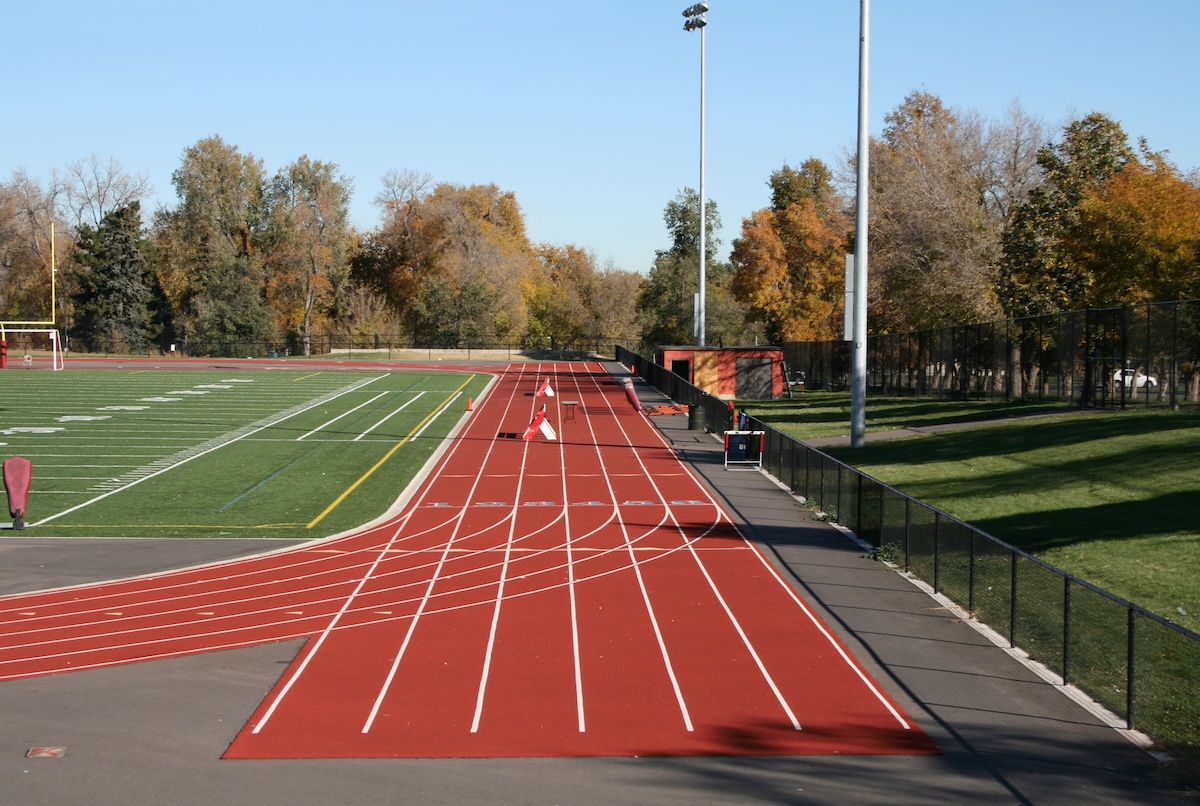
Turfing all the way to the track gets rid of those narrow bands of grass along the curb that still need mowing and watering, and it gives teams one consistent surface across the sideline areas. Keeping grass in the D-zones reduces the synthetic area. Those zones stay on the maintenance schedule, though, and the irrigation lines have to be rerouted around the new field. If any field event areas sit in the D-zones, their surfaces get planned right alongside the turf layout.
Stormwater Review
Changing a field’s surface can bring a stormwater review along with it. Agencies don’t all classify synthetic turf the same way. It can vary from one state to the next, and sometimes between a city and the county right next door. In some areas, a turf field may be considered an impervious area, in the same category as pavement. In other areas, they may give credit for all the water the stone base can store or let soak into the ground below, which can reduce the separate stormwater measures a site needs.2 The stone has a good bit of open space between the rocks, so it can hold rainwater and let it out slowly to the drains.
Either way, the classification can affect the permit timeline and whether the project needs to add detention or treatment features. A detention feature is a spot to hold runoff for a while, like a pond or an underground tank, while treatment features clean the water before it leaves the property.
Protecting the Track During Construction
Every load of stone, every truck hauling soil away, and every piece of grading equipment has to get across the track to reach the field inside it.
That’s a lot of heavy traffic over a surface built for humans to run on, and loaded trucks and turning equipment can damage it. So the construction plan lays out how the oval will be protected for the length of the project, which may include steps like:
- One designated crossing point, with the fence opened up at that spot and all construction traffic routed through it
- Heavy-duty crossing mats, or layered plywood over protective sheeting, anywhere vehicles cross the lanes
- Protective covers on the inside lanes where crews are working along the edge of the field
- Regular sweeping at the crossing to keep mud and stone off the running surface
Once the field work wraps up, the coverings come up and the track gets swept clean of any stone and infill. The crossing route and the inside edge usually get extra attention during the final inspection, since those are the areas that carried the most construction traffic.
Typical Steps for Replacing Grass with Artificial Turf in a Sports Field
For the most part, a conversion follows the same order as new turf field construction, with removal and regrading added at the front end. Field work is often scheduled for the offseason so the new surface is ready by the time fall practice starts. Weather, permitting, and material deliveries can all affect how the phases line up on any given site.
Here’s a look at the phases in the order they might typically happen. Of course on some projects the steps can overlap somewhat, with drainage and curb work running at the same time on different parts of the field, just for example. The exact methods may also vary with the turf system and the design.
Strip the grass + rootzone
First, crews remove the sod along with the rootzone, which is the layer of soil or sand the grass was growing in. Irrigation heads and lines inside the new turf area get taken out or capped, while any lines that still serve nearby grass areas are rerouted. The removed material is either hauled away or reused somewhere else on the site, depending on its quality and the site plan.
Remove the crown + shape the subgrade
The subgrade is the native soil the new field will rest on. Equipment cuts down the crown and digs to whatever depth the base design calls for, then laser-grades the soil, using a laser-guided reference to hold the design slope across the whole field. Next, the subgrade is compacted and proof-rolled (basically, driving a loaded vehicle across it to find any soft spots), and unsuitable soil is removed or stabilized.
Install the drainage system
Trenches are cut across the field for perforated pipe, laid in either a herringbone or parallel pattern, which carries water over to a collector drain around the perimeter. From there, the collector connects to the site’s storm system. A geotextile (a permeable filter fabric) is often placed over the subgrade as well, to keep native soil from working its way up into the stone.
Set the perimeter curb + in-ground fixtures
The turf needs a fixed edge to fasten to. That’s commonly a concrete curb fitted with a nailer board, a strip of wood or composite that the turf gets attached to along its border. This is also when ground sleeves for goals, corner flags, and other equipment are set, along with conduit for anything that might need to run under the field later on. Existing goalpost foundations are checked against the new finished grade, as well.
Build the stone base
Permeable crushed stone is placed in layers, compacted, and laser-graded. The turf follows the base exactly, so even a small dip or ridge in the stone will show up on the finished field. That’s why the base gets checked for grade and smoothness before any turf goes down.
Install the artificial turf
Once the base is approved, synthetic turf installation can begin. If the design includes a shock pad, that goes down first. Then the turf panels are unrolled, seamed together, and fastened at the perimeter. Lines, numbers, and logos are either inlaid with turf in a contrasting color or tufted right into the panels at the factory.
Spread infill + test the surface
Infill, which is commonly a blend of sand and rubber or an alternative material, is spread in several passes and brushed into the fibers. It helps hold them upright and cushions play. Before the field opens, it’s tested for Gmax, a measure of how much impact force the surface transmits, following the ASTM F1936 standard for turf playing fields.
Where the Field Meets the Track
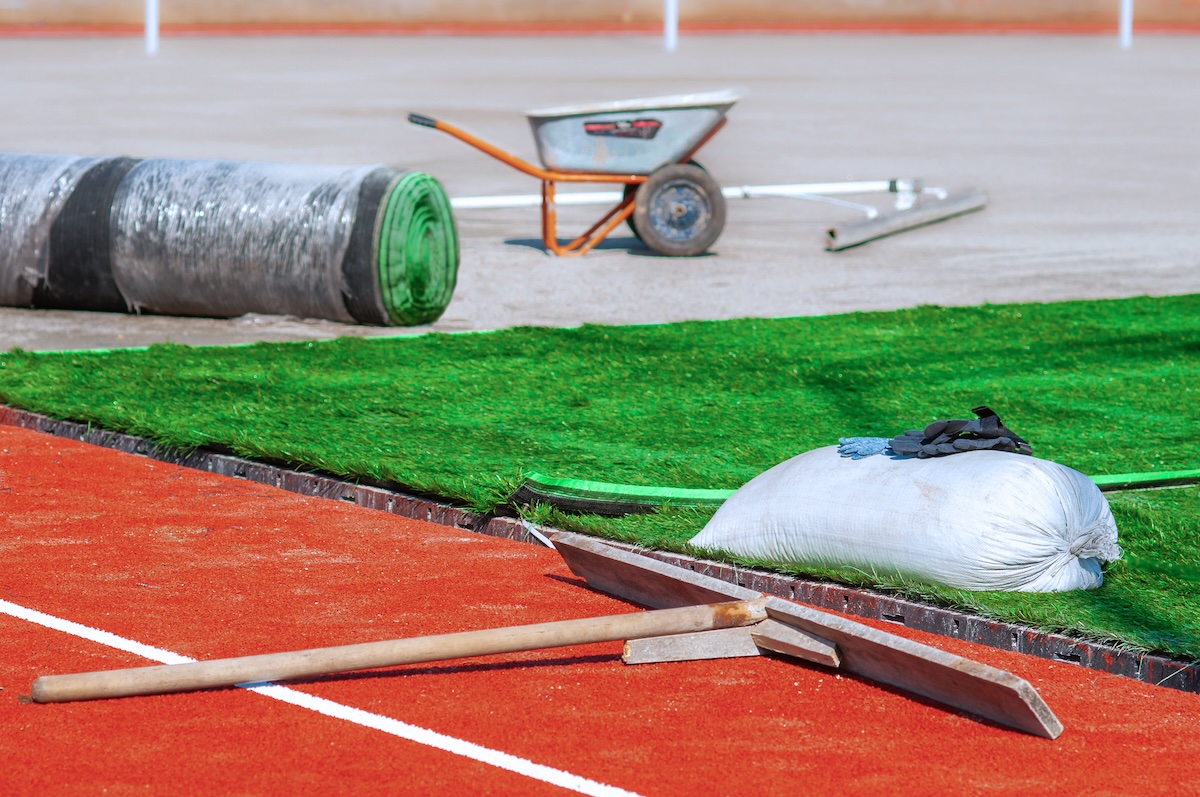
A track is sloped so water drains toward its inside lane, which sends runoff from the running surface to the inside edge of the oval. On a crowned grass field, water from the field heads toward that same edge, just from the other direction. After a conversion, the field’s water drains down into the stone base, while the track keeps shedding its water toward the inside edge, the same as before.
That means the drain along the edge, often a trench drain or a perforated line beside the curb, gets evaluated during design. Its condition, capacity, and elevations all help determine whether the new field’s perimeter collector ties into it or runs to the storm system on its own. If you’d like more background, our overview of sports field drainage covers how grading and subsurface systems work together.
The finished heights along that line are all set together. The top of the turf, the perimeter curb, and the track’s edge are designed to meet cleanly, without a lip that could catch a foot or a cleat. The edge detail affects routine upkeep as well, since infill that migrates off the field tends to settle right where the turf meets the curb.
Planning for Future Turf Replacements
The base and drainage built during a conversion are designed to outlast the turf on top of them. That’s helpful down the road. When the surface eventually reaches the end of its service life, the turf and infill come off, the base gets inspected, and a new system can go down on the existing base as long as it’s still in good shape. Old turf can go through sports field removal and recycling, which keeps that material out of landfills.
It’s a good idea to hold on to the as-built records from the conversion, since they can make that future project simpler to plan. Drawings that show final grades, drain pipe locations, sleeve and conduit positions, and the storm system connection give the next design team a clear starting point, without anyone having to dig to find them.
Frequently Asked Questions
Q: Does a grass field need new drainage to become a turf field?
A: Usually, yes. A synthetic field drains through its base, so it relies on a pipe network beneath the stone. Some grass fields already have drain lines, and the site survey will show whether any of them can be reused, but their depth and spacing often differ from what a turf base calls for.
Q: Does a synthetic turf field still have a crown?
A: It can. Some turf fields keep a shallow crown, but at a much lower slope than the grass field had. Others are graded as a single plane that falls gently toward one side. Which approach a site uses depends mostly on the existing grades and where the drainage outlets are.
Q: What happens to the grass and soil removed from the field?
A: That depends on the soil quality and the site plan. It’s either hauled off site or reused for grading somewhere else on the property.
Q: When should a school start planning a conversion?
A: Field construction is usually scheduled for the offseason so the turf is ready in time for fall sports. Surveying, design, stormwater review, funding approval, and public bidding all have to happen before that window opens, so it helps to work backward from the date the field needs to be ready and set the design start from there.
No two sports facilities start from the exact same grades, soils, or drainage, so planning to change a field from natural grass to artificial turf begins with a close look at the field and the track as they are today.
UDC Sports plans, designs, and builds both natural grass and synthetic turf athletic fields. If you’d like to discuss a field conversion or other sports construction project, give us a call at 828-518-5787 or click here to contact our team.
References
1. 2023-24 Soccer Field Diagram. National Federation of State High School Associations. https://assets.nfhs.org/umbraco/media/7212134/2023-24-nfhs-soccer-field-diagram-final.pdf
2. Technical Memorandum #2: Alternative Surfaces and Artificial Turf. Maryland Department of the Environment. https://mde.maryland.gov/programs/Water/StormwaterManagementProgram/Documents/Technical-Memorandum2-alternative-surfaces-and-artificial-turf.pdf

