
Last Updated on September 4, 2026 by UDC Sports
Athletic fields get built by several different kinds of companies, and the differences between them are not obvious from a website. A firm that installs synthetic turf is not the same as a general contractor that builds athletic facilities, and neither is the same as a site contractor that moves dirt well but has never laid out a gridiron.
For a school, church, university, or parks department putting a field out to bid, sorting that out early tends to determine how the project goes. This covers what football field builders do, how the different types of firms are structured, what distinguishes firms that build athletic fields regularly, and what to ask before anyone signs.
What Football Field Builders Handle
The turf is the last thing installed and the smallest part of the job. Most of a field project happens below grade, and most of the schedule is consumed before anything green shows up on site. A football field construction company running the full scope is responsible for clearing and grubbing the site, cut-and-fill earthwork to bring the subgrade to design elevation, compaction testing, installing a subsurface drainage network, building and laser-grading an aggregate base, installing the surfacing system, and setting the perimeter components that make the field usable: goalpost foundations, curbing, fencing, netting, and often lighting and spectator infrastructure.
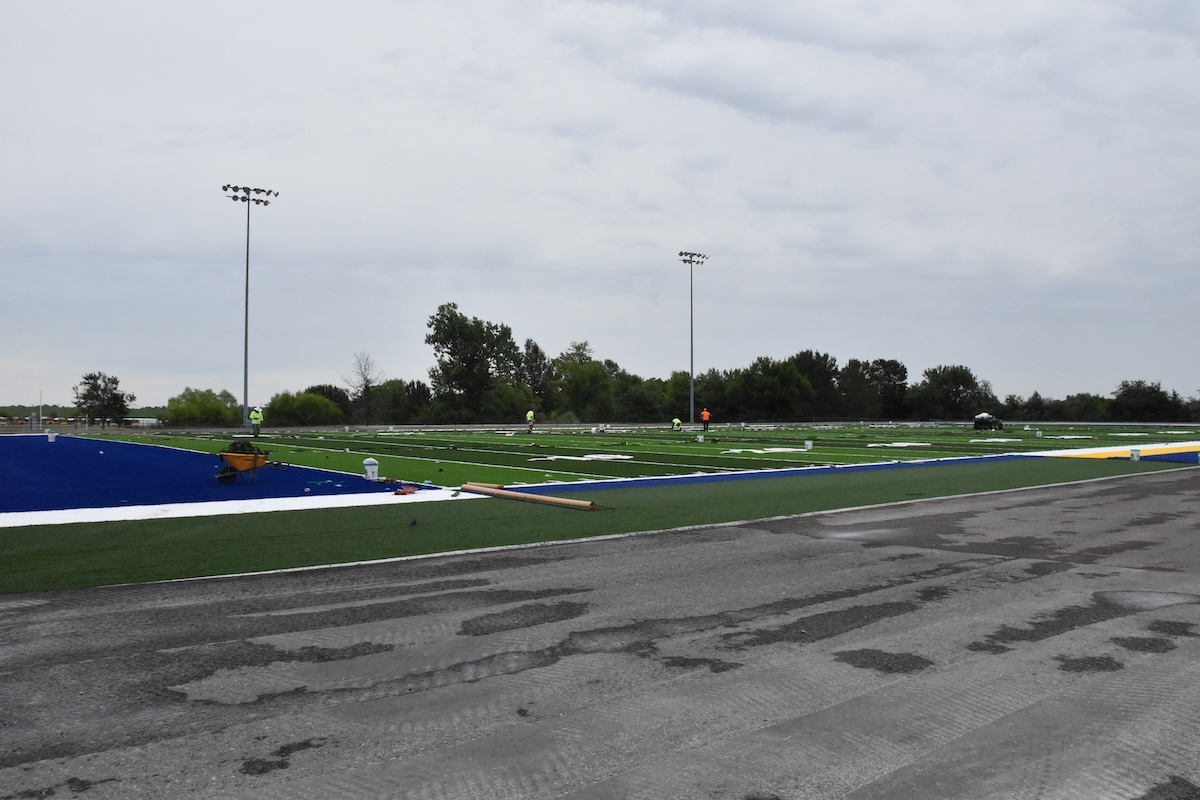
Alongside that sits the coordination work that owners rarely see. Permitting and stormwater review, erosion and sediment control, utility locates and sleeving, materials testing, submittals, inspections, and sequencing a half-dozen trades so that nobody arrives before the work in front of them is finished. On a field project the sequence is unforgiving, because each layer permanently covers the one beneath it.
Different Kinds of Sports Construction Firms
Companies that will bid a football field come from four fairly distinct backgrounds, and the one you want depends on how much of the project you intend to manage yourself.
The distinction matters most, of course, if something goes wrong. A single responsible party makes a warranty claim simpler. Three separate contracts can make it a conversation about whose fault it was.
Sports Facility General Contractors
These firms hold the prime contract and carry the whole project, from site assessment through closeout. They self-perform some scope and subcontract the rest, and they own the schedule, the sequence, and the result. For an owner without a construction department, this is usually the lowest-friction arrangement, since one company answers for the field.
Turf Installation Contractors
Turf installers specialize in the surfacing system: panel layout, seaming, inlaid markings, shock pad, and infill. Many are excellent at that work and nothing else, which means the owner or another contractor still has to deliver a finished, correctly graded base for them to install onto. If a turf installer is bidding your project, confirm in writing where their scope begins.
Site and Excavation Contractors
General site contractors move earth and install drainage competently, and some cross over into athletic work. The gap is tolerance. Ordinary site grading is measured in inches; a field base is commonly specified to a fraction of an inch across a ten-foot straightedge, and irregularities telegraph through the finished surface as visible waves or spots that hold water.
Design-Build Firms
Design-build athletic field contractors carry both the design and the construction under one contract. Owners who prefer a single point of accountability from concept through completion tend to favor this route, though it does mean the design and the price are developed by the same party, so an independent review of the drawings has value.
The Standards a Football Field Builder Has to Hit
Athletic field construction is measured against published specifications, and a qualified builder works from them rather than from habit. Two categories govern the finished product: the governing body’s dimensional rules, and the safety performance standards for the surface.
Both are verifiable. An owner can check a completed field against either one, which makes them useful questions during selection.
Dimensional Standards by Level of Play
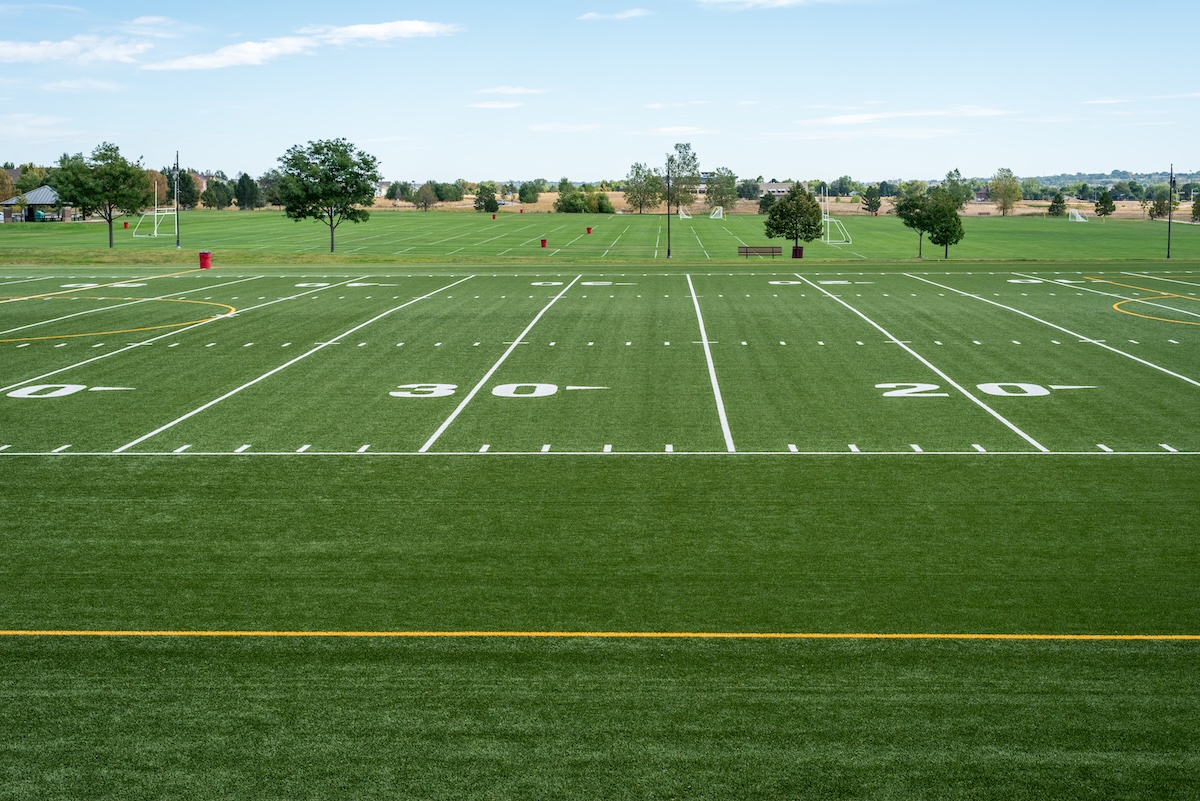
Every level of American football uses the same overall footprint, 360 feet by 160 feet, or 120 yards by 53 1/3 yards, which works out to 57,600 square feet, roughly 1.32 acres. What changes between levels is the interior geometry, and getting it wrong produces a field that cannot host sanctioned play at that level.
| Element | High school (NFHS) | College (NCAA) | Professional (NFL) |
|---|---|---|---|
| Overall field | 360 ft x 160 ft | 360 ft x 160 ft | 360 ft x 160 ft |
| End zone depth | 10 yards | 10 yards | 10 yards |
| Hash marks from sideline | 53 ft 4 in | 60 ft | 70 ft 9 in |
| Distance between hashes | 53 ft 4 in | 40 ft | 18 ft 6 in |
| Goalpost uprights | 23 ft 4 in apart | 18 ft 6 in apart | 18 ft 6 in apart |
| Crossbar height | 10 ft | 10 ft | 10 ft |
Hash placement is the specification most often overlooked in early planning, and it changes the geometry of the entire markings package. Hash spacing has been narrowed at the college and professional levels over the years, so older reference material circulates with outdated figures. Rulebooks are revised periodically, and a builder should be working from the current edition for the governing body that will sanction play on the field.
Surface Safety Testing
Synthetic fields are tested for impact attenuation, reported as a Gmax value, which measures the peak deceleration a surface transmits during an impact. Lower values indicate a softer landing.
The governing standard is ASTM F1936, Standard Specification for Impact Attenuation of Turf Playing Systems as Measured in the Field, which covers North American football fields specifically and establishes a maximum permissible value. The test method it references is ASTM F355, and the field procedure involves dropping an instrumented missile three times at each of several locations across the field, with the first drop conditioning the infill and the following two averaged.

Gmax rises as infill compacts with use, so a single test at substantial completion is a baseline rather than a permanent result. Owners commonly establish that baseline at handover and retest periodically across the field’s service life, using the results to guide grooming, infill top-dressing, and eventual replacement planning. A builder who can speak to this without prompting has done it before.
Specific thresholds, test frequencies, and governing rulebook editions change over time. Confirm current requirements with the applicable governing body and with the project’s design team rather than relying on figures published anywhere online, including here.
Tips to Help You Evaluate Football Field Builders / Contractors
Most of what separates athletic field construction companies shows up before a contract is signed, in the specificity of their answers and the substance of what they can show you. These are some of the areas that can be informative.
Licensing, Bonding, and Insurance
General contractor licensing requirements vary by state and by project type. Public work typically requires performance and payment bonds, and most institutional owners carry insurance requirements of their own. Verifying that a bidder can be bonded for the size of your project is a simple screening step, and it filters out firms operating beyond their capacity.
Self-Performed Versus Subcontracted Scope
Every general contractor subcontracts some work. What matters is knowing which portions, because the parts a firm self-performs are the parts it has direct control over. A contractor that self-performs earthwork and base construction has direct control over the two phases that determine long-term performance. A firm that subcontracts those phases can deliver the same result, and the outcome rests more heavily on its subcontractor relationships and its site supervision.
Warranty Structure
Synthetic turf systems carry a manufacturer’s warranty on the product. The installation carries a separate warranty from the contractor, and the base and drainage carry another. Understanding where each one begins and ends, and who administers a claim that touches more than one, is good to sort out before construction commences on the football field.
Questions to Ask Football Field Construction Companies
These are some of the questions that can come up on football field construction projects, and covering them before awarding the contract tends to prevent them from surfacing as change orders later.
- What grading tolerance are you holding on the base, and how is it verified? Tolerance and verification method are both things a builder should be able to describe.
- Who designed the drainage, and what happens to the water? A field is a drainage system with a playing surface on top. The builder should be able to trace the path from the base to the outfall.
- What compaction testing is included, and who performs it? Whether testing is done in-house or by an independent lab is a reasonable thing to have defined in the scope.
- Which governing body’s specifications are we building to? NFHS, NCAA, and NFL geometry differ, and the striping plan follows from the answer.
- What sports besides football will this field host? Soccer is wider than football, and the overall surface has to be sized for the widest sport in the group.
- Is baseline Gmax testing part of the scope, and where do the results go? A baseline gives you something to measure later testing against.
- What does the schedule assume about weather, and where is the float? Earthwork is weather-dependent, and a schedule with no slack is a schedule that will slip.
Football Field Construction Projects
Institutional owners generally select a builder through one of three routes, and the route shapes who ends up bidding.
Competitive bid is standard for public work. The design is completed first, the project goes out to bid, and award typically goes to the lowest responsive and responsible bidder. It is transparent and it works, provided the specification is written tightly enough that everyone is pricing the same field.
Request for qualifications or proposals lets an owner weigh experience, references, and approach alongside price. Schools and universities frequently use this when a straight low-bid award has produced problems on past projects.
Design-build puts design and construction under one contract, awarded on qualifications and a proposal rather than on a completed drawing set. It compresses the schedule and reduces the number of parties, which suits owners working toward a fixed season opener.
Churches, private schools, and private facility owners are generally free to negotiate directly with a contractor, which shortens the process considerably. Public entities usually cannot, and their procurement rules should be confirmed before any conversation with a builder gets specific.
Signs a Bidder May Not Be the Right Fit
None of these disqualify a firm on their own, though each one is a reason to ask another question.
- A project schedule with no weather contingency in front of a fixed season date.
- Vague answers on grading tolerance, drainage design, or compaction testing.
- A bid that shows no evidence anyone looked at the site or read the geotechnical report.
Timeline and Season Deadlines

Athletic construction runs on a calendar set by the sport. Most projects are scheduled backward from a season opener that does not move, which puts pressure on the front of the schedule rather than the back.
Survey and geotechnical work, design, and permitting all precede construction, and each carries its own duration. Programs targeting a specific opening date generally benefit from beginning the planning process a year or more ahead, particularly where funding approval, a capital campaign, or a public bid process is part of the sequence.
Earthwork and base construction consume the largest share of the construction schedule and are the most weather-dependent. Saturated subgrade cannot be compacted properly, and a wet spring can stall grading for weeks. Turf installation is comparatively quick once the base is right.
Frequently Asked Questions
Q: What kind of company builds football fields?
A: Sports facility general contractors handle the full scope and carry single-point responsibility for the finished field. Turf installation contractors handle only the surfacing and require a finished base to install onto. Site and excavation contractors handle earthwork and drainage. Design-build firms combine design and construction under one contract.
Which fits depends on how much of the project the owner intends to manage and coordinate directly.
Q: Can a general construction company build an athletic field?
A: Some can. The difference is tolerance and specification familiarity. Field bases are graded to a fraction of an inch, drainage is designed for surfaces that shed water vertically rather than across a crown, and finished dimensions have to match a governing body’s published rules. Those are learnable, though a sports field project is a difficult place to learn them, since the parts most affected are the ones that get permanently covered.
Q: Can the same contractor handle both the base and the turf?
A: When the base and the surfacing sit under one contract, a problem with either has one responsible party. Split contracts are workable and common, though they require the owner or a construction manager to coordinate the handoff and to resolve any dispute about which scope caused a defect.
Q: How long does building a football field take?
A: Construction duration varies with site conditions, scope, permitting, and weather, with earthwork and base work consuming the largest share. The full timeline for how to build a football field, from first conversation to first game is considerably longer than construction alone, since survey, geotechnical investigation, design, and permitting all come first.
Q: What should be in the closeout package?
A: As-built drawings showing what was installed and where, warranty documentation for the turf system and the installation, a maintenance manual, and baseline Gmax test results the field will be measured against in later testing. That package determines how well the facility gets maintained after the contractor leaves.
Q: What causes problems in fields years after they are built?
A: Most long-term failures trace to work below the surface. Inadequate compaction produces settlement and low spots. Undersized or poorly configured drainage leaves water in the base. A base graded outside tolerance shows through as waves in the finished surface. All of it is invisible at handover and difficult to correct afterward, since reaching it means removing the playing surface.
Choosing among football field builders is largely a question of scope and accountability: how much of the project one firm carries, how specifically they answer questions about the work below grade, and what they can show you from fields that have been in service long enough to prove the base underneath them.
UDC Sports is a general contractor specializing in sports field construction, building athletic fields, training facilities, and multi-purpose complexes for schools, churches, universities, and municipalities.

