

Last Updated on June 2, 2026 by UDC Sports
Whether you’re building a community recreation facility, a high school stadium, or a professional-grade football complex, turf football field construction is one of the most technically involved projects in sports infrastructure. Decisions made at the planning stage affect player safety, long-term maintenance costs, drainage performance, and the field’s useful lifespan — often by years.
This guide covers every phase of the construction process: site evaluation, base engineering, turf selection, drainage design, installation, and post-build maintenance. It’s written for facility managers, school districts, municipal planners, and sports organizations navigating the process for the first time or upgrading an existing field.
Note: This guide is written for general educational purposes. Most information in this guide including but not limited to specifications, material standards, local regulations, site conditions, and more can vary by geography, project scope, and governing body, and they can also change over time. The figures, thresholds, and practices described here reflect commonly cited industry references and should be treated as a starting point for research, not as a substitute for the judgment of a licensed engineer, qualified contractor, or sports field construction professional. Anyone planning a turf football field construction project should verify all specifications and regulatory requirements with credentialed professionals familiar with their specific site and jurisdiction before making any decisions.
Table of Contents
- Football Field Dimensions and Layout Standards
- Synthetic Turf vs. Natural Grass: Choosing the Right Surface
- Site Evaluation and Geotechnical Assessment
- Drainage System Design for Football Fields
- Sub-Base Construction and Compaction
- Synthetic Turf System Components
- The Installation Process, Step by Step
- Field Markings and Accessory Systems
- Lighting, Fencing, and Surrounding Infrastructure
- Turf Football Field Construction Costs
- Construction Timeline
- After Installation
- Selecting a Turf Field Construction Contractor
- Frequently Asked Questions
1. Football Field Dimensions and Layout Standards

Before any ground is broken, the construction team needs a precise layout plan based on governing body specifications. Dimensions vary by level of play.
NFL and NCAA Standard Fields
- Total field dimensions: 360 feet long × 160 feet wide (including end zones)
- Playing field: 100 yards (300 feet) between goal lines
- End zones: 10 yards (30 feet) each
- Hash marks: 18 feet, 6 inches apart (NFL); 40 feet apart (NCAA)
High School Fields (NFHS)
- Playing area dimensions are the same as collegiate
- Hash marks: 53 feet, 4 inches apart
Youth and Pop Warner Fields
- Scaled down based on age group; field length ranges from 80 to 100 yards
- End zones are typically 10 yards each
How much land do you need to build a football field? Beyond the playing surface itself, the construction footprint must account for team benches, sideline buffer zones (typically 6 to 12 feet of clear space outside the white lines), surrounding track if applicable, and spectator safety barriers. A standard high school football field with surrounding buffer zones requires roughly 2 to 2.5 acres of cleared, level land.
Orientation also matters. North-south orientation minimizes direct sun glare in players’ eyes during afternoon games. East-west orientation increases sun exposure throughout the day, which benefits natural grass growth but can create visibility problems during play. Most new constructions favor a slight northeast-southwest alignment to balance both concerns.
2. Synthetic Turf vs. Natural Grass: Choosing the Right Surface
The choice between artificial turf and natural grass shapes every other decision in the project, including base construction method, drainage engineering, maintenance program, and budget over a 10 to 25 year horizon.
Synthetic Turf
Modern synthetic turf systems consist of polyethylene or nylon fibers tufted into a backing and installed over a shock-absorbing infill layer. They support year-round, heavy-use schedules without recovery time between events.
Advantages of synthetic turf:
-
- Fields support significantly more weekly use than natural grass without requiring recovery time between events
- No irrigation, mowing, fertilization, or overseeding required
- Consistent playing surface in rain, snow, and cold temperatures
- Lower cumulative maintenance costs over the system’s lifespan
- Playable within hours of heavy rain when drainage is properly engineered
Limitations of synthetic turf:
- Higher upfront installation cost compared to natural grass
- Surface temperatures run 30°F to 60°F higher than ambient air on hot days
- Periodic infill replacement and fiber grooming required throughout the system’s lifespan
- Full system replacement required at end of useful life
- Chemical concerns with certain older infill materials (crumb rubber and alternative infills are discussed in Section 6)
Natural Grass
Natural grass fields remain preferred at the professional level for many outdoor stadiums and are appropriate for facilities with lower weekly usage and dedicated turf management staff.
Advantages of natural grass:
- Lower installation cost compared to synthetic turf
- Cooler surface temperatures in summer
- No PFAS or microplastics concerns
- Long-term sustainability when properly managed
Limitations of natural grass:
- Requires rest periods between heavy uses and cannot sustain the same weekly use volume as synthetic turf without deteriorating
- Vulnerable to deterioration from weather, drought, and heavy foot traffic
- Annual maintenance costs for irrigation, aeration, overseeding, and pest control add up significantly
- Recovery time after games can render the field unavailable for days
Hybrid systems are a growing middle ground, combining a natural grass matrix with synthetic fiber reinforcement. These systems (sold under names like Desso GrassMaster and SIS Hybrid) are used in NFL and MLS stadiums where a natural look is required but traffic loads exceed what pure natural grass supports.
For most high schools, universities, and municipal facilities, synthetic turf delivers better utilization economics over a 15-year window, particularly when the field is shared among multiple sports and community events.
3. Site Evaluation and Geotechnical Assessment
No two construction sites are identical, and the underlying soil conditions directly determine what kind of base system is required, what drainage infrastructure must be installed, and how the grading will be engineered.
Soil Borings and Geotechnical Testing
A licensed geotechnical engineer takes soil borings at multiple points across the proposed field footprint, typically to a depth of 10 to 15 feet. The borings reveal:
- Soil classification (clay, loam, sand, gravel, or mixed profiles)
- Load-bearing capacity
- Groundwater depth and seasonal variation
- Presence of expansive soils that swell and contract with moisture
- Rock layers that may require blasting or mechanical removal
Heavy clay soils are the most problematic for turf construction. Clay retains water, expands when wet, contracts when dry, and creates frost heave in cold climates. Fields built on clay without adequate base preparation develop uneven surfaces, soft spots, and drainage failures within a few years.
Sandy or loamy soils drain naturally and provide a stable, compactable base. Construction on favorable native soils can meaningfully reduce total project cost compared to sites that require extensive base preparation.
Grading and Slope Requirements
Football fields are graded with a crown or slope to direct rainwater toward perimeter drains or internal drainage systems. Two standard grading profiles are used:
Crown profile: The field is highest at the center and slopes down approximately 1% (about 1 inch per 8 feet) toward both sidelines. This is the most common configuration for fields without subsurface drainage.
Flat with perimeter drainage: Fields with engineered subsurface drainage systems can be built nearly flat (0.5% slope or less), which is preferred for multi-sport use.
The grading must achieve tolerances within ±0.1 feet across the entire field surface before the base layers are placed. Laser-guided grading equipment is standard on professional sports field projects.
Environmental Permitting
Depending on site location, construction may require:
- Stormwater pollution prevention plans (SWPPP)
- Wetlands delineation and setback compliance
- Impervious surface permits
- Environmental impact assessment if the site is near sensitive natural areas
Permitting timelines vary widely by jurisdiction, and in many states environmental permitting alone can add significant time to the pre-construction phase.
4. Drainage System Design for Football Fields

Poor drainage is the single most common cause of premature field failure, surface heaving, and unplayable conditions. Drainage design is among the most technically demanding parts of football field construction.
Surface Drainage
Surface drainage moves water off the field quickly via slope. A minimum surface slope of 0.5% is recommended; 1% is more effective for fields in high-rainfall regions. Water flows to perimeter trenches lined with perforated pipe, which routes it to a storm drain or retention basin.
Subsurface Drainage
Subsurface drainage removes water that penetrates below the surface, which is especially important under synthetic turf systems where the backing’s perforation rate ranges from 20 to 50 inches per hour on new installations. Two main approaches:
French drain (pipe-and-gravel) systems: Perforated pipes are placed in gravel-filled trenches, spaced 5 to 15 feet apart across the field. Water infiltrates through the base layers, enters the pipes, and flows by gravity to an outlet. This system works well in moderate-rainfall regions and is the most common choice.
Slit drain systems: A series of narrow trenches (4 to 6 inches wide) filled with coarse sand or gravel are cut at close spacing across the field. Slit drains handle extremely high rainfall rates and are used on professional fields where rapid post-storm playability is a priority.
Chip drain systems: A layer of uniformly-graded angular stone (ASTM #57 or #8 aggregate) is placed beneath the turf base as a free-draining layer before connecting to perimeter outlets. Chip drainage is less expensive than slit drain systems and delivers drainage rates sufficient for most educational and municipal applications.
Drainage Outlets and Retention
The drainage system must connect to an approved outlet: a municipal storm sewer, a detention pond, or a constructed bioswale. Many jurisdictions require on-site stormwater retention to meet impervious surface regulations, which means the drainage design must incorporate volume calculations for the field’s full catchment area.
5. Sub-Base Construction and Compaction
The sub-base is the structural foundation beneath the turf system. Its quality determines how well the field holds its shape, drains, and performs under years of repeated compaction loads from players, maintenance equipment, and freeze-thaw cycles.
Clearing and Excavation
After permitting and grading design are finalized, the construction crew strips the existing surface vegetation and topsoil to a depth of 12 to 24 inches, depending on what the geotechnical report specifies. Any organic material, unstable fill, or unsuitable native soil is removed and replaced with engineered fill.
Sub-Base Materials
Recycled crushed stone (Class II or Class V aggregate): The most common sub-base material for football fields. Crushed stone is compacted in lifts (typically 4 to 6 inch layers) to achieve 95% to 98% Modified Proctor density. It provides excellent load bearing and free drainage.
Lime or cement stabilization: On sites with high-clay native soils, adding quicklime or Portland cement to the existing subgrade reduces plasticity, increases bearing capacity, and prevents heave. This is a cost-effective alternative to full subgrade replacement on problem sites.
Asphalt or concrete base: Some synthetic turf systems, particularly indoor fields and certain high-performance outdoor installations, use a paved base. Asphalt and concrete provide a rigid, perfectly flat surface, but they require additional shock-absorbing layers above them to meet player safety standards. Paved bases are also more expensive and complicate future drainage modifications.
Sub-Base Thickness
A typical synthetic turf field sub-base profile from bottom to top looks like this:
- Compacted native subgrade or engineered fill
- 6 to 8 inches of compacted crushed stone base
- Drainage layer (perforated pipe in aggregate, or chip drain)
- 2 to 4 inches of finished aggregate or stone dust leveling course
- Geotextile fabric (prevents fines migration upward)
- Shock pad (optional but common on modern installs)
- Synthetic turf system
The total depth from bottom of excavation to top of turf surface typically ranges from 12 to 20 inches.
6. Synthetic Turf System Components
A synthetic turf system is an engineered product stack, not a single material. Understanding its components helps facility owners make specification decisions that affect player safety, performance, and longevity.
Fiber Type and Pile Height
Polyethylene (PE) fiber: The dominant material in modern football turf. PE fibers are soft, durable, and resistant to UV degradation. They come in monofilament (single-strand) and slit-film (flat ribbon) configurations. Monofilament fibers deliver better blade recovery (they stand back up after compression); slit-film is denser and more abrasion-resistant.
Nylon fiber: Harder and stiffer than polyethylene, nylon was used in earlier generations of artificial turf and remains in use for some indoor and special-application fields. It creates higher surface friction and faster wear on exposed skin.
Pile height for football turf typically falls between 2 inches (50mm) and 2.75 inches (70mm). Taller pile heights create a more natural look and softer feel but require more infill to maintain upright fibers.
Backing System
The turf carpet’s backing consists of primary and secondary layers, typically woven polypropylene, with tuft-bind adhesive holding fibers in place. Perforations in the backing every few inches allow water to pass through into the drainage system below.
Infill Materials
Infill is the granular material brushed into the turf pile to support fiber upright posture and provide shock absorption. The infill layer typically accounts for 60% to 80% of the system’s G-max (shock attenuation) performance.
Crumb rubber (SBR): Recycled tire rubber, the most widely used infill material for 20+ years. Cost-effective and durable, but subject to ongoing research and regulatory scrutiny around heavy metal leaching (zinc, cadmium, PAHs) and potential chemical exposure. Many school districts have moved away from crumb rubber as alternatives have become cost-competitive.
EPDM rubber: Engineered rubber granules with a lower chemical concern profile than crumb rubber. Widely specified for school, church, and youth football fields/sports facilities, though buyers should still request third-party PFAS certification, as trace PFAS has been detected in some EPDM products.
TPE (thermoplastic elastomer): A synthetic rubber alternative that is clean, recyclable, and carries the lowest chemical concern profile of the rubber-based infills. TPE is the most common premium infill choice in the current market.
Organic infills (cork, coated sand, coconut fiber): Lower-temperature alternatives that reduce surface heat buildup. Organic infills require more maintenance and annual top-dressing to maintain depth.
Sand-only systems: Some fields use washed silica sand as the sole infill, particularly in combination with higher-performance shock pads. Sand systems are simpler to maintain and avoid infill-related health concerns.
Shock Pad Layer
Shock pads are a 10mm to 25mm layer of foam, recycled rubber, or engineered aggregate placed between the sub-base and the turf carpet. They improve G-max performance (impact absorption), HIC (head injury criterion) scores, and foot-to-surface traction.
Shock pads have become near-standard on new football field installations, driven by player safety requirements from governing bodies. The Synthetic Turf Council recommends G-max values below 165 on the ASTM F355 scale, which is the most widely referenced threshold in the industry and used as a benchmark by the NFL and many state athletic associations.
Shock pads extend the usable life of the turf system by reducing the compaction forces that degrade infill and fiber roots, and they allow thinner infill depths without sacrificing safety performance.
7. The Installation Process, Step by Step
Once base construction is complete, the turf installation crew takes over. Relative to the base work, turf installation moves quickly, with pace depending on crew size, field complexity, and weather conditions.
Step 1: Final Base Inspection and Acceptance
Before any turf is rolled out, the installation supervisor verifies that the sub-base has been laser-graded to tolerances and passes compaction testing. Any soft spots, low areas, or grade deviations greater than 3/8 inch over a 10-foot span are corrected at this stage. Corrections after turf is laid are extremely costly.
Step 2: Shock Pad Installation (If Specified)
Shock pad panels are rolled or placed across the prepared base, seamed at joints, and secured with adhesive or mechanical fasteners depending on the manufacturer’s system. Seams must be flat and tight to prevent ridges under the playing surface.
Step 3: Turf Roll Layout
Turf arrives on-site in rolls of 15 feet wide and up to 150 feet long, weighing 1,500 to 2,500 pounds each. A forklift or turf buggy is used to position each roll. Rolls are laid parallel to the field’s long axis (sideline to sideline) for football fields, as this minimizes the number of seams in the high-traffic center of the field.
Turf fiber direction matters. All rolls must be installed with fibers oriented in the same direction (typically toward one end zone) to ensure consistent light reflection and color uniformity. Mismatched fiber direction creates visible striping that cannot be corrected after installation.
Step 4: Seaming
Adjacent rolls are trimmed to eliminate overlap, then bonded with seaming tape and adhesive at the joints. Seams that fall in the center of the field (high-wear zones) are reinforced with additional adhesive or sewn seams on premium installations. Properly executed seams are nearly invisible to spectators and hold for the full life of the turf system.
Step 5: Perimeter Anchoring
At the field edges, the turf is stretched tight, trimmed to the specified border dimensions, and anchored to a nailer board, concrete curb, or steel edge restraint. Perimeter anchoring prevents lifting and edge separation, which is among the most common maintenance problems on poorly installed fields.
Step 6: Infill Application
Infill is loaded into a powered infill drop spreader and applied in multiple passes until the manufacturer-specified depth is reached. Between passes, a tractor-mounted broom or power brush grooms the fibers upright and distributes infill evenly throughout the pile. Achieving uniform infill depth is critical; low spots create inconsistent footing and accelerated fiber wear.
Step 7: Field Markings
Football field lines are painted, inlaid, or created with contrasting-color turf panels. Each method has different durability and cost profiles (see Section 8 for full detail).
Step 8: Final Inspection and Testing
Before the field is accepted, the contractor performs:
- G-max testing at multiple locations to verify shock attenuation meets specified thresholds
- Surface levelness check with a straight edge and measuring device
- Seam inspection under tension
- Drainage flow test (running water onto the surface and verifying clearance rate)
- Infill depth probing across the full field area
A qualified third-party inspector, independent of the contractor, should perform or witness final testing on all public and institutional projects.
8. Field Markings and Accessory Systems
Marking Methods for Synthetic Turf
Painted markings: Synthetic turf-compatible latex paint is the lowest-cost option. Painted lines require repainting several times per season under heavy use and fade significantly between applications. Paint can accumulate on fiber tips with repeated applications, affecting drainage and aesthetics.
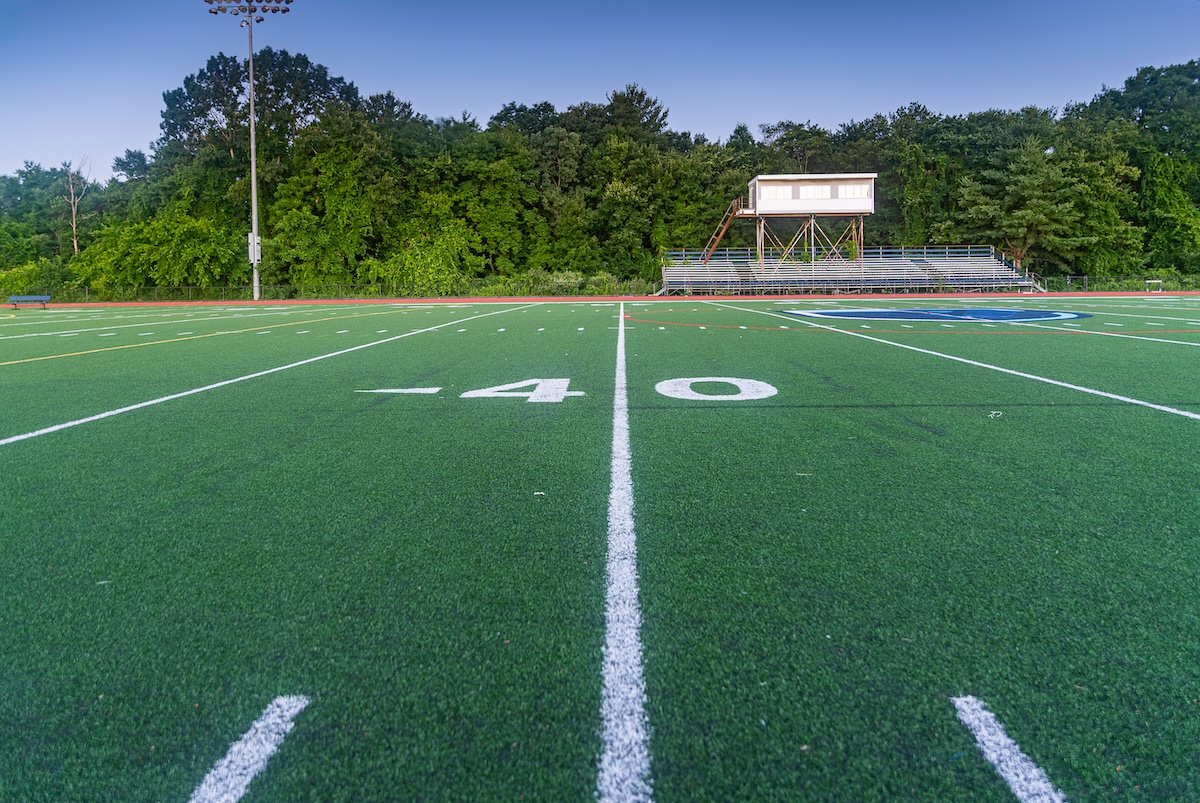
Inlaid turf markings: The preferred method on nearly all new synthetic field installs. White (or yellow, for hash marks and goal post pads) turf panels are cut to precise shapes and seamed into the field during installation. Inlaid markings are permanent, never fade, and have no maintenance requirement. The cost premium over painted markings is typically recovered over time through avoided repainting costs.
Stencil-applied infill markings: A specialized method where white infill is applied through stencils to create temporary markings. Used primarily on multi-sport fields where football lines need to be periodically replaced with soccer or lacrosse configurations.
Goal Posts
Goal posts are set in concrete foundations that must be placed before the sub-base is finished. Sleeve-type goal post anchors allow goal posts to be removed for non-football events; fixed posts are simpler and lower cost but prevent multi-sport use. Goal post sleeve foundation depth is typically 4 to 6 feet depending on post height and soil conditions.
Sideline and End Zone Equipment
- Team bench pads: rubber-backed turf sections that define the bench area and provide traction on sidelines
- Yardage markers: painted or inlaid at every 5 yards; numbered at every 10 yards
- Player entrance tunnels: often paved or carpeted separately from the field surface
- Corner flags: require ground sleeves installed before turf is laid
9. Lighting, Fencing, and Surrounding Infrastructure
A turf football field project typically encompasses more than the playing surface itself. Budgeting and coordinating the surrounding infrastructure early prevents costly retrofits later.
Field Lighting
Modern LED sports lighting systems are the standard for new football field construction. Metal halide systems were dominant until the early 2010s but have been replaced by LED for their lower operating cost, faster warm-up time, and improved light uniformity.
Key lighting specifications for football fields:
- Recreational and community use: 30 to 50 foot-candles (fc) average horizontal illuminance
- High school competition: 50 to 75 fc
- College and broadcast-quality: 100 to 150+ fc; vertical illuminance requirements for camera angles add to fixture count and cost
Pole placement around a football field typically uses 4 to 8 poles positioned beyond the sidelines and end zones. Pole heights range from 60 feet to 120 feet. Taller poles with wider beam angles improve uniformity and reduce spill light onto neighboring properties.
Fencing and Perimeter
Perimeter fencing around a football facility serves crowd control, security, and revenue functions (controlled ticketed access). Chain-link fencing with vinyl coating is standard for school and municipal facilities. Decorative aluminum or tubular steel fencing is common at higher-budget programs.
Fencing setback from the field must account for sideline buffer zones. A minimum 15-foot setback from the field sideline to any hard barrier is recommended for player safety.
Press Box and Bleachers
Press box and bleacher foundations must be designed and permitted independently from the field construction. Their footings cannot interfere with the field’s subsurface drainage outlets. Bleacher placement on the west sideline is preferred to keep spectators shaded during afternoon games.
Concession, Restroom, and ADA Facilities
Any facility open to the public must comply with ADA accessibility standards, including accessible seating areas, accessible routes to restrooms and concessions, and compliant parking within a defined distance. These elements are typically handled by a separate architect and civil engineer but must be coordinated with the field construction project from the start.
10. Turf Football Field Construction Costs
Cost varies based on field size, base conditions, turf system specifications, geographic region, and site access. The cost to build a simple football field can vary substantially, and understanding which components drive cost helps owners prioritize budget and evaluate bids accurately.
Synthetic Turf Field Cost Drivers
A synthetic turf football field project has several distinct cost components, each influenced by site-specific conditions:
Earthwork, grading, and drainage is often the most variable line item. Sites with poor native soils, high groundwater, or significant elevation changes require more excavation, engineered fill, and drainage infrastructure than sites with stable, well-draining subgrade. This component can range from a minor expense on a favorable site to the largest single cost on a challenging one.
The synthetic turf system itself (supply and installation) typically represents the largest share of total project cost. Turf system price varies by fiber type, pile height, backing specification, infill material, and whether a shock pad is included. Premium systems with engineered shock pads and low-chemical-concern infills cost more than entry-level configurations.
Engineering, testing, and contractor overhead are fixed costs that scale with project complexity. Geotechnical investigation, drainage design, G-max testing, and third-party inspection are non-negotiable on institutional projects and should be budgeted from the start.
Adding lighting, bleachers, fencing, and press box infrastructure increases total project cost substantially over the field construction cost alone. Facilities that combine all site elements into a single construction contract often achieve better pricing than those that phase work separately.
Natural Grass Field Cost Drivers
Natural grass fields have a lower upfront construction cost than synthetic turf, but the ongoing annual expenses for irrigation, mowing, aeration, overseeding, fertilization, and pest control accumulate significantly over time. On a well-maintained high school or college field, annual maintenance spending is a meaningful recurring budget commitment.
15-Year Cost Comparison Framework
When evaluating synthetic turf against natural grass, total cost of ownership over a multi-year horizon gives a more accurate picture than upfront construction cost alone. The comparison must account for: initial construction, annual maintenance, periodic turf replacement as synthetic systems have a finite lifespan that varies by use intensity and maintenance quality, and lost revenue or scheduling constraints during field downtime.
Synthetic turf fields carry higher initial construction costs but substantially lower annual maintenance costs and far greater weekly use capacity. Natural grass fields cost less to build but more to maintain annually, and their limited weekly use hours reduce their value per dollar for high-traffic facilities. The crossover point depends on local labor rates, maintenance program quality, and how heavily the field is used each week.
11. Construction Timeline

A synthetic turf football field project moves through four broad phases, each with its own variables. Actual duration at each stage depends on site complexity, contractor availability, weather, and how much of the surrounding infrastructure is being built concurrently.
Phase 1: Planning and Design
- Site survey and geotechnical investigation
- Field design and engineering
- Permit applications and environmental review
- Bidding and contractor selection
Phase 2: Base and Drainage Construction
- Site clearing, grubbing, and rough grading
- Storm drain and subsurface drainage installation
- Sub-base placement and compaction in lifts
- Fine grading and base acceptance testing
Phase 3: Turf Installation
- Shock pad installation
- Turf roll layout, cutting, and seaming
- Perimeter anchoring
- Infill application and grooming
- Field marking application
Phase 4: Accessories and Closeout
- Goal post installation
- Sideline furnishings
- Final G-max testing and inspection
- Punch list and project closeout
Planning and permitting typically drive the overall schedule more than construction itself. Permit timelines vary significantly by jurisdiction, and projects that begin construction before permits are secured risk costly delays. A qualified contractor who works regularly in your region will have a better read on local approval timelines than any general estimate can provide.
Weather matters during installation. Adhesive seaming and infill application both perform best in dry, moderate temperatures. Winter construction in cold climates is possible but introduces scheduling risk that can affect cost and quality. Most projects target a spring or summer construction window to give the field time to be ready for the fall season.
12. After Installation

Synthetic turf earns its reputation for low maintenance when you compare it to what a natural grass program actually demands: weekly mowing, irrigation management, fertilization schedules, pest and weed control, aeration, overseeding, and extended recovery windows after heavy use or wet weather. None of that applies to a synthetic field. What remains is a lighter, more predictable set of tasks focused on keeping the infill distributed, the fibers upright, and the drainage clear. Staying on top of those tasks also matters for warranty compliance, since most turf manufacturers require a documented maintenance program as a condition of coverage.
Routine Maintenance Tasks
Weekly (during active use season):
- Drag or groom the field surface with a tractor-mounted power broom to keep fibers upright and redistribute infill
- Inspect seams and perimeter edges for separation or lifting
- Remove debris, leaves, and trash
- Check drainage inlets for blockage
Monthly:
- Add infill to low spots or high-wear areas (center field, hash mark areas, frequent running lanes)
- Inspect shock pad for exposed areas or compression
- Test and record G-max at multiple field zones
Annually:
- Comprehensive infill depth survey and top-dressing
- Deep cleaning with specialized turf cleaning equipment to remove compacted organic material from infill
- Full G-max and HIC testing per ASTM standards
- Seam and anchor inspection
- Fiber density and pile height measurement to track wear progression
Managing Heat on Synthetic Turf
Surface temperatures on synthetic turf fields can reach 150°F to 200°F on hot summer days when dark infills like crumb rubber are used. Mitigation strategies include:
- Switching to lighter-colored or organic infill, which can meaningfully reduce surface temperatures compared to dark rubber infills
- Pre-game cooling with water application (provides temporary relief but accelerates infill migration)
- Shade structures over sideline areas
- Scheduling early morning or evening practices during heat periods
End-of-Life Planning
Synthetic turf systems carry manufacturer warranties that vary by product and system tier, and functional lifespan varies further based on use intensity and how consistently the field is maintained. Planning for eventual replacement from the start allows facilities to build replacement reserves and evaluate emerging turf technologies when procurement arrives.
Used synthetic turf can be recycled through programs operated by major turf manufacturers and third-party recyclers, though turf-to-new-material recycling infrastructure is still developing in many U.S. regions. Disposal must comply with local solid waste regulations.
13. Selecting a Turf Football Field Construction Contractor
The contractor selection process determines whether a project comes in on schedule, on budget, and with a surface that performs as specified. Key factors to evaluate:
Experience and References
Request a list of completed football field projects from the past 5 years with contact information for the facility owner or manager at each site. Visit two or three completed fields if possible; a field that looks good 3 years after installation is a stronger indicator than a freshly opened one. Ask specifically about:
- Whether the field passed initial G-max testing on the first attempt
- Whether there were seam failures within the first 2 years
- How responsive the contractor was to warranty claims
Turf Manufacturer Partnerships
Most turf installers are authorized to install specific brands of turf. Some work with multiple manufacturers and can competitively bid the turf supply component separately from the installation. Evaluate whether the proposed turf product has independent third-party test data for G-max, fiber durability, and infill stability, not just the manufacturer’s literature.
Base Construction Capability
Some turf installers subcontract the earthwork and base construction to a site contractor they’ve never worked with before. This creates coordination gaps and diffuses accountability. Firms that self-perform or have established partnerships with dedicated sports field base contractors deliver more consistent results.
Warranty Terms
Warranty coverage typically addresses turf fiber UV resistance and color retention, seam integrity, infill material stability (when the infill is supplied by the turf manufacturer), and shock pad compression set. Coverage periods and what each component covers vary by manufacturer and product tier. Read the full warranty document before signing a contract, including all conditions required to keep coverage valid.
Bid Structure
A comprehensive bid for turf football field construction should include:
- Separate line items for earthwork, drainage, sub-base, turf, markings, and accessories
- Specified turf product by manufacturer, product name, fiber type, and pile height
- Specified infill type, depth, and total weight per square yard
- G-max performance guarantee at installation
- Perimeter anchoring method
- Reference to applicable standards (ASTM, FIFA, SFMA)
Lump-sum bids that don’t break down components are difficult to evaluate and even harder to audit if disputes arise.
14. Frequently Asked Questions (FAQ)
How long does it take to build a synthetic turf football field?
Timeline depends heavily on site conditions, permitting, and project scope. A straightforward field-only project where permits are already in hand moves considerably faster than one that involves significant earthwork, lighting, or bleacher construction. Your contractor can give you a realistic schedule once the site has been evaluated, since local permitting timelines alone vary enough to make general estimates misleading.
How much does a turf football field cost?
A synthetic turf football field (field only, without lighting or bleachers) varies widely depending on size, base conditions, and turf system specifications. Full facility projects that include lighting, fencing, and seating add substantially to that base cost. Request itemized bids from multiple qualified contractors to establish accurate pricing for your specific site and requirements.
How long does synthetic turf last on a football field?
Lifespan depends on how heavily the field is used, how consistently it is maintained, and the quality of the system installed. High-use fields wear faster; fields with diligent maintenance programs last longer. Manufacturer warranties vary by product and should be reviewed carefully, including the conditions required to keep them valid.
Is synthetic turf safe for football players?
When installed and maintained to current ASTM standards for G-max and HIC, synthetic turf meets established player safety thresholds. Infill material selection addresses the most common health concern for facilities that want to minimize exposure to tire-derived materials. A qualified installer can walk you through current product options and the testing protocols that apply to your governing body’s requirements.
What is G-max testing and why does it matter?
G-max measures the peak deceleration force transmitted to a player’s head during a fall, expressed as a multiple of gravitational force. The Synthetic Turf Council publishes a recommended maximum threshold on the ASTM F355 scale, which serves as the most widely referenced industry benchmark. Testing is performed with a drop hammer device, and results vary across the field surface depending on infill depth and temperature. Periodic testing is standard practice to verify the field continues to meet safety requirements over its lifespan.
What infill should we specify if we’re concerned about PFAS?
TPE and organic infills (cork, coated sand) are the primary alternatives to crumb rubber with the lowest chemical concern profiles. EPDM has a better profile than crumb rubber but trace PFAS has been detected in some products, so independent certification matters regardless of infill type. Request written certification from the infill manufacturer confirming PFAS content below detectable limits per an appropriate total fluorine testing standard.
Can you build a turf football field indoors?
Yes, indoor turf football fields are built in pre-engineered steel buildings with concrete or asphalt base systems. Ceiling clearance requirements vary depending on whether the facility needs to accommodate punting and kicking. Indoor facilities require mechanical ventilation and specialized lighting, and construction cost runs higher per square foot than comparable outdoor projects.
Who needs to be on the project team for a turf field construction project?
A complete project team includes: an owner’s representative or project manager (often an in-house facilities director), a sports field architect or civil engineer for design, a geotechnical engineer for soil investigation, a licensed turf installer, a general contractor or earthwork subcontractor, and an independent third-party inspector for base acceptance and final testing. Large projects may also involve a landscape architect, a structural engineer (for press boxes and bleachers), and a lighting consultant.
Do synthetic turf fields drain well enough to play after heavy rain?
A properly engineered field with subsurface drainage handles rainfall quickly enough that fields are typically playable soon after a storm clears. Drainage performance depends on the quality of the original installation and how well the system has been maintained, since infill compaction reduces drainage capacity over time. Your contractor can walk you through the drainage design and expected performance for your specific site conditions.
Note: This guide is written for general educational purposes. Most information in this guide including but not limited to specifications, material standards, local regulations, site conditions, and more can vary by geography, project scope, and governing body, and they can also change over time. The figures, thresholds, and practices described here reflect commonly cited industry references and should be treated as a starting point for research, not as a substitute for the judgment of a licensed engineer, qualified contractor, or sports field construction professional. Anyone planning a turf football field construction project should verify all specifications and regulatory requirements with credentialed professionals familiar with their specific site and jurisdiction before making any decisions.

