
Last Updated on October 31, 2026 by UDC Sports
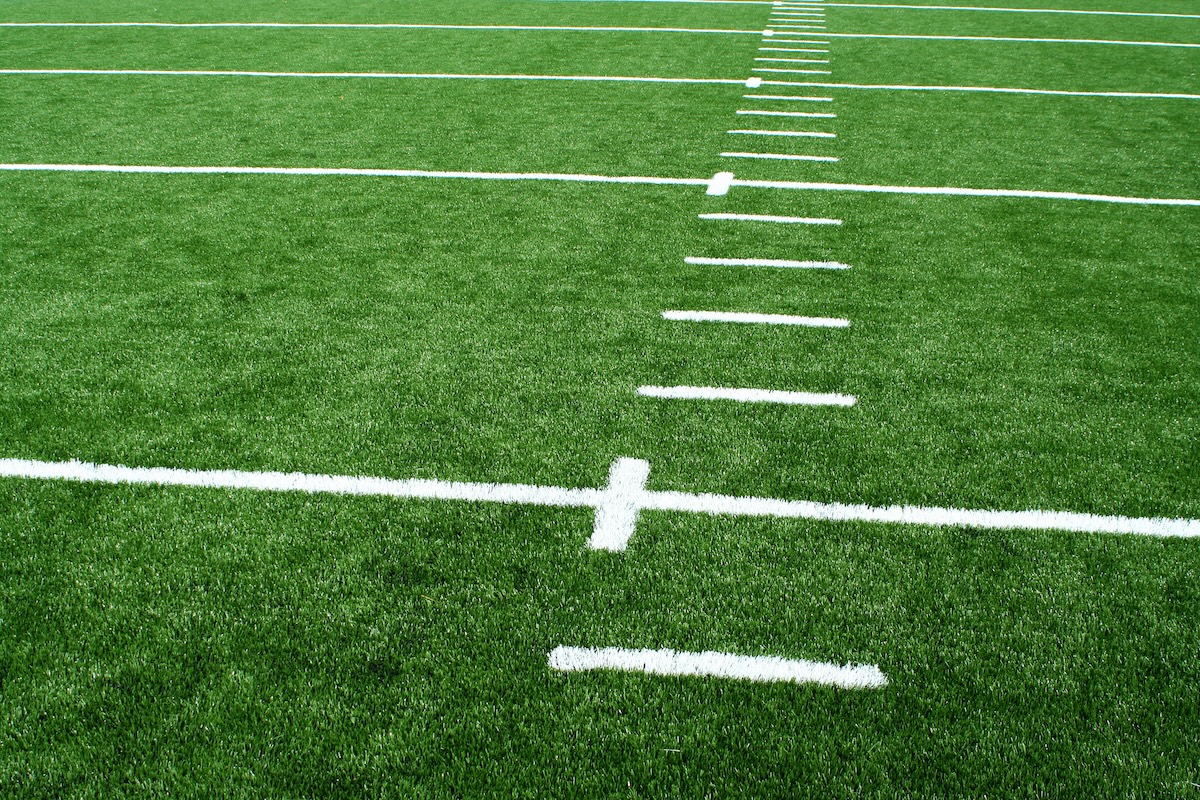
A new football or soccer field takes a lot of work before the first kickoff: site grading, drainage, a compacted stone base for artificial turf, and a playing surface chosen for the sports it will host, right down to the logo at midfield.
Once the field opens, G-max (or Gmax) testing is a widely-used way to track how that surface absorbs impact. And it’s about as low-key as field testing gets, with a weighted test device, a set of marked spots, and a few drops at each one. In a way, it’s like a preseason physical for the playing surface.
Testing comes up at several stages of a field’s life. A new synthetic grass field will often be tested at completion to confirm the surface and record a starting point, with some routine tests in the years that follow help owners plan maintenance and, eventually, sports field resurfacing. The same in-field test applies to natural grass and indoor turf, along with fields lined for more than one sport.1
What Is G-Max Testing?

G-max testing measures how hard a playing surface is. A test device fitted with an accelerometer, a sensor that measures changes in speed, is dropped onto the field, and the instrument records how quickly the device decelerates when it lands.
The peak reading, expressed in multiples of the acceleration of gravity, is the G-max value. A lower number means the surface absorbed more of the impact, and a higher number points to a harder surface.2,3
The method comes from ASTM International. ASTM F355 describes the drop test, and ASTM F1936 applies it to turf playing systems in the field, with test-point layouts for specific sports and a protocol for fields lined for more than one sport.1,2
Some public owners, including the District of Columbia’s Department of General Services, publish their annual field results, which gives a sense of how schools and parks departments use the test.2
How a G-Max Test Is Performed
Formal testing is often handled by an independent testing firm or field consultant. However, some owners and contractors also run interim checks between formal tests.
Exact procedures depend on the standard and the provider, but tests generally follow the same basic sequence.
Laying out test points
Test locations are marked across the field, with attention to the high-use areas where wear tends to show first. ASTM F1936 sets point locations for specific sport layouts.1
Dropping the test device
At each point, the device is raised to a set height and released onto the surface. Edina’s program, just for example, describes a 20-pound device dropped from 24 inches.3
Repeating the drops
Several drops are made at each location. In Edina’s program, the reported value for each spot is the average of the second and third of three drops.3
Checking infill depth
On infilled synthetic turf, some programs also measure infill depth at each drop site. The Sports Turf Managers Association notes that infill depth has a strong effect on G-max.3,4
Reporting the results
Readings are reported point by point, often with a field map, so owners can see where the surface is firmest and compare it with earlier tests.
Testing at the same points, ideally at the same time of year, is what makes the results useful over the years. Each season’s readings can then be compared with the last, and any area that is drifting firmer stands out early.
G-Max Testing in New Sports Field Construction
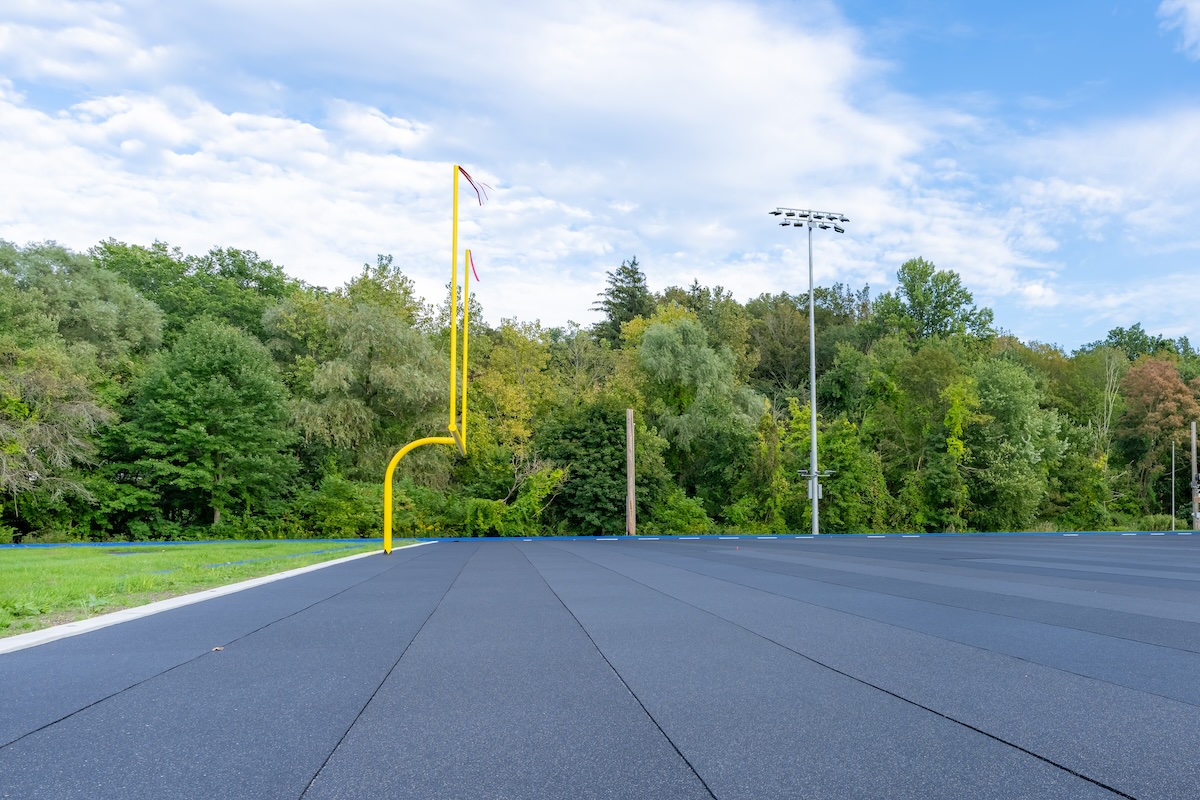
On a new build, impact performance is planned long before anyone drops a test device on the finished surface.
The turf system, infill, shock pad, and base are selected together during design, and the completed field is often tested before it opens to confirm the surface and record a baseline. The installation steps in turf football field construction typically end with that final inspection and testing. That baseline becomes the reference point for every test that follows.
Several construction choices have a direct effect on how a field reads on opening day and how those readings change as the seasons add up.
Shock Pads
A shock pad is a resilient layer installed under the turf carpet. In a 2020 article, the Synthetic Turf Council’s president described its main job as providing a permanent layer of impact absorption regardless of the turf on top, and the council’s shock pad guidelines call for pads durable enough to perform through at least two turf carpets.5
Pads can also help keep a field’s resilience more uniform and reduce infill compaction over time.5
Infill Type and Depth
Infill, the sand, rubber, or alternative granules worked between the turf fibers, can carry much of the cushioning on a synthetic field. Because infill depth has a strong effect on G-max, installed depth is planned carefully on new fields and checked regularly afterward.4 Different infill materials can feel and perform differently, so the turf, infill, and any pad are typically tested as one system.
Turf Fibers and Pile Height
The turf fibers hold infill in place. As fibers wear and flatten in high-traffic areas, infill can shift or compact, and those spots often test firmer than the rest of the field.2 Pile height, the length of the fibers above the backing, is chosen alongside infill depth so the two work together from the start.
The Stone Base
Under the turf system, the compacted stone base gives the field a firm, level platform and carries water toward the drains.
Impact absorption comes largely from the layers above it, the pad, infill, and fibers, while the base supports them evenly. Because of that, what goes under artificial turf affects how consistently the finished field plays from sideline to sideline.
G-Max Testing on Football Fields
American football is hard on a field. Linemen dig in and drive off the turf on every snap, players hit the ground all the time, and practices repeat the same drills in the same spots. And those are just a few of the reasons!
Wear tends to concentrate between the hash marks and near the middle of the field, so football fields are typically tested at high-use points in addition to the rest of the playing area.1,2
Football field construction plans for that workload. A shock pad is often considered for football turf, infill depth is set for the system being installed, and testing is frequently scheduled before the season so firm spots can be groomed or topped up before two-a-days start. The base, drainage, and turf system that football field builders put in place at the start can help the field test consistently in later seasons.
G-Max Testing on Soccer Fields
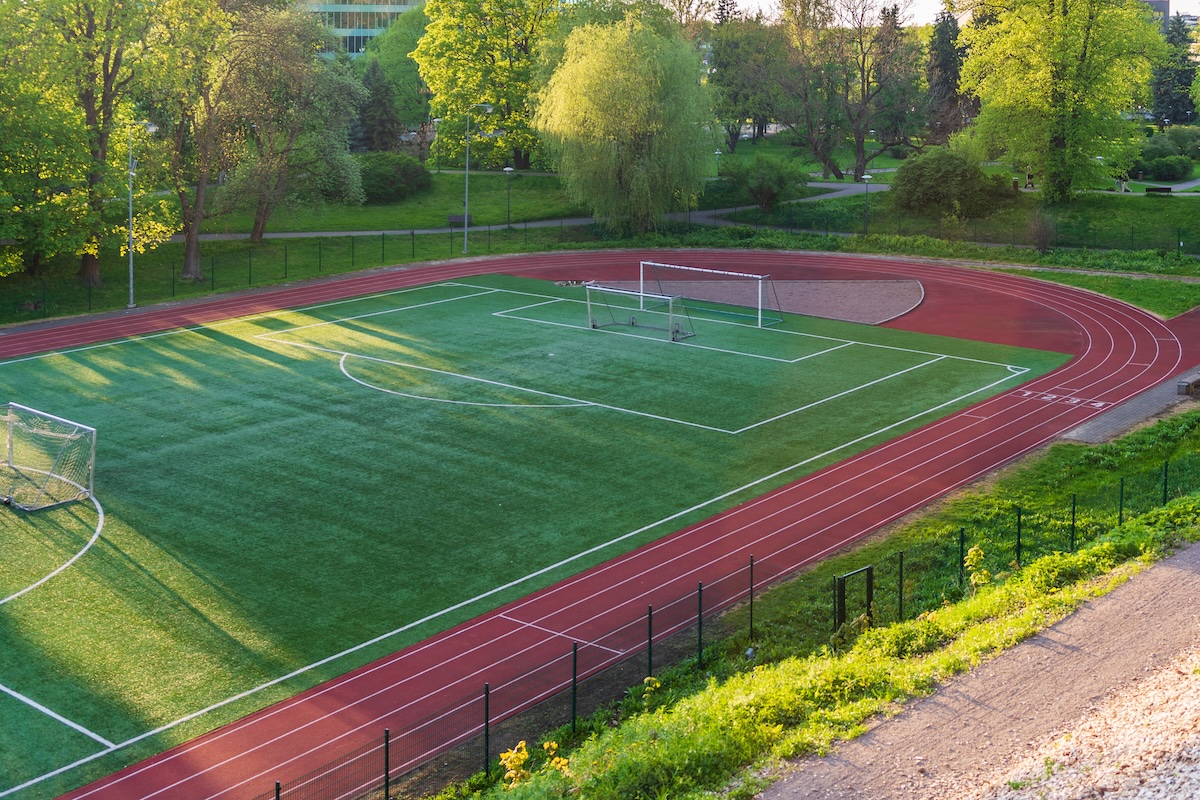
Naturally, soccer field construction brings some of its own priorities. Play spreads across a large area, the heaviest wear tends to show up in the goal mouths, the center of the field, and the corners, and the way the ball rolls and bounces is part of how the surface is judged. G-max testing applies to soccer fields too, and the Synthetic Turf Council’s shock pad guidance notes that pads can help control ball rebound in sports such as soccer.5
Fields built for higher levels of play may also pursue certification through the FIFA Quality Programme. Certification involves laboratory testing, installation, and field testing, and a field that passes is certified as FIFA Quality or FIFA Quality Pro.6
FIFA’s tests use a device called the Advanced Artificial Athlete to measure shock absorption, vertical deformation (how much the surface gives underfoot), and energy return.6
Those measurements and G-max values come from different devices and are reported in different units, so the two sets of numbers aren’t directly comparable. When a soccer field is tested both ways, each set of results is compared against its own standard and its own history.
The same planning applies whether the field is a high school pitch or a club complex. Soccer field builders typically choose the fiber type, infill, and pad together so the surface meets the program’s goals for footing, ball roll, and impact absorption.
Multi-Sport Fields and Indoor Turf Facilities
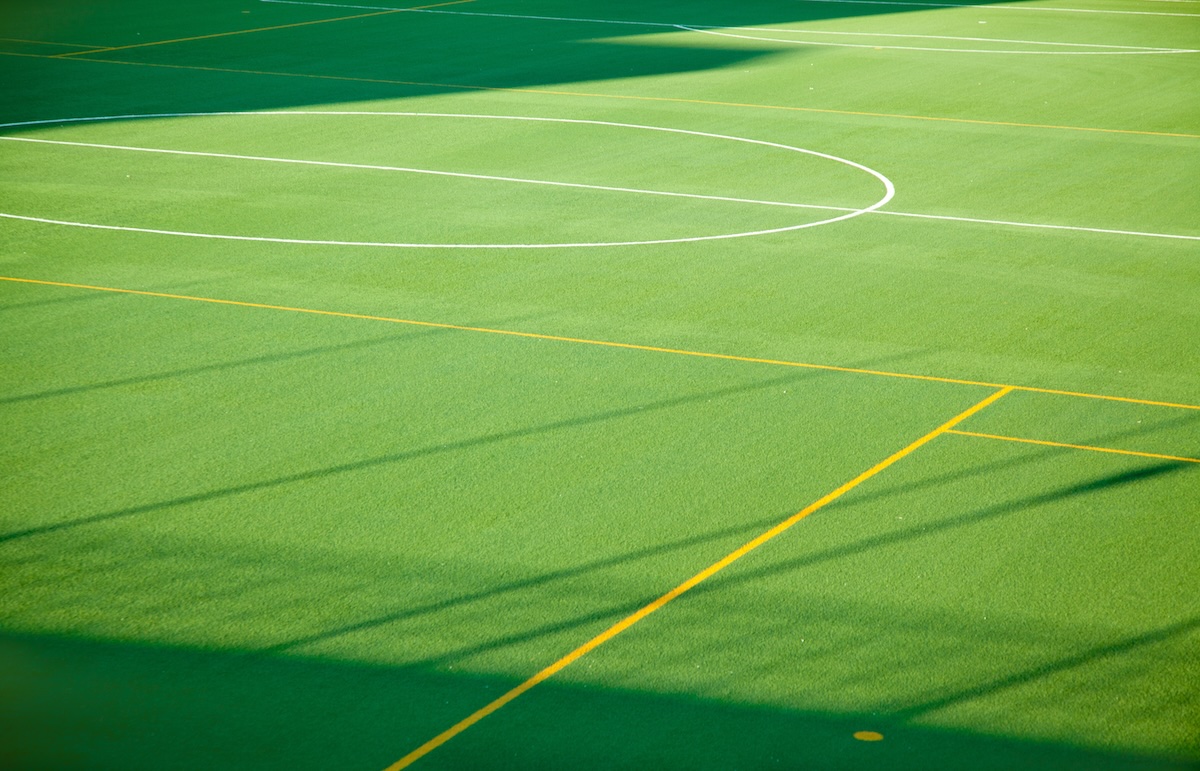
School and community fields often host football in the fall, soccer and lacrosse in the spring, and youth leagues on weekends.
ASTM F1936 includes a protocol for choosing test points on fields lined for more than one sport, so testing can cover the areas each sport uses most.1 In multi-sport field design, line layouts and high-use zones overlap, and the test plan follows the sports the field hosts.
Indoor turf is tested the same way. ASTM F1936 covers turf playing systems indoors and outdoors,1 and indoor fields used for football, soccer, and lacrosse training rely on the same combination of infill, pile height, and pad or subfloor to manage impact. Those choices are part of planning to build an indoor sports facility or training center from the start.
Natural Grass Athletic Fields and Impact Testing
G-max testing isn’t limited to synthetic turf. ASTM F1936 covers natural grass playing systems as well.1 On a grass field, firmness can change with soil moisture, compaction, and maintenance, so readings may vary from one part of the season to another, and testing under similar conditions makes year-to-year comparisons more useful.
Construction choices carry over to grass fields too. Sand-based rootzones, the growing layer where grass roots develop, along with subsurface drainage and regular aeration and topdressing, are common tools for managing firmness on natural grass. Sports field surface installation for grass fields involves the same kind of up-front planning as synthetic turf, from the rootzone to the irrigation system.
Reading G-Max Test Results
A G-max report lists a value for each test point, and three things stand out when reading one: the highest readings, how the zones compare with each other, and how the numbers have moved since the last test.
ASTM F1936 sets a maximum of 200 at any test point, a ceiling cited by some public organizations.1,2,3 Some owners act well before readings approach that ceiling. Edina Public Schools in Minnesota, for example, sets its own lower trigger point for corrective work such as dragging the field or adding infill.3
A field’s testing provider and maintenance plan can help set an action level that fits the system installed and how heavily the field is used.
Results can shift with conditions on test day, including temperature and moisture, so comparisons are most useful when readings are taken at the same points, at a similar time of year, and ideally by the same testing provider.
How Often Turf Fields Are Tested
The Sports Turf Managers Association recommends testing synthetic fields at least once a year, with more frequent testing for fields that see heavy use.4 Public programs that publish their schedules show a similar rhythm. For a few examples across the country, the District of Columbia tests its synthetic fields annually, and Edina Public Schools tests every spring through an independent firm, even though Minnesota does not require it.2,3
Beyond a yearly schedule, testing fits naturally at several other points in a field’s life, from the day a new surface is finished to the seasons when owners start weighing resurfacing. Here is when tests typically happen and what the results are used for.
| Testing Point | When It Happens | What the Results Are Used For |
|---|---|---|
| Acceptance test | When a new field or new surface is complete | Confirming the installed surface and setting a baseline |
| Preseason test | Before the busiest part of the year | Finding firm spots in time for grooming or added infill |
| Routine test | At least once a year, more often with heavy use | Tracking trends and planning maintenance |
| Follow-up test | After grooming, infill work, or repairs | Confirming the work brought readings down |
| Resurfacing planning | As the field nears the end of its service life | Weighing timing alongside fiber wear and seam condition |
Keeping G-Max in Range With Field Maintenance
Rising readings on synthetic turf often trace back to infill that has compacted or shifted. The District of Columbia notes that its test results help identify compaction and the possible need for more infill, and that grooming or top-dressing can lower readings.2 Common maintenance steps include:
- Grooming and brushing to loosen compacted infill and stand fibers back up
- Top-dressing, which adds infill where depth has dropped
- Decompaction with equipment designed to loosen packed infill
- Seam and spot repairs in high-wear areas
- A follow-up test to confirm the work brought readings down
Routine care between formal tests can include grooming, infill checks, and seam inspections, and a field maintenance checklist organizes field care by season. Keeping notes on what was done and when makes the next G-max report easier to interpret.
When G-Max Results Point Toward Resurfacing
Maintenance can bring many fields back into range. As a synthetic field ages, though, worn fibers hold infill less effectively, and readings may creep back up soon after each round of grooming or top-dressing.
A rising trend alongside matted fibers, recurring seam repairs, and slow drainage lines up with the signs owners use to judge when to replace a turf football field. The next step typically falls into one of three categories.
Grooming and infill top-off
On a field with sound fibers and seams, grooming and added infill are typically the first steps, followed by a test to confirm the readings came down.
Sectional repairs or replacement
Localized wear, such as a goal mouth or a heavily used practice area, can sometimes be addressed in sections.
Resurfacing
When readings, fiber wear, and seam condition point the same way, resurfacing replaces the turf carpet and infill, while the base, drainage, and sometimes the shock pad stay in service after inspection.
When a field has given all it can, resurfacing starts with turf removal and recycling. The worn carpet and infill come up, the old materials head off for reuse or recycling, and the base gets a close look before anything new goes down. The new surface typically gets its first G-max test once installation wraps up, and those readings become the baseline for every season that follows.
That first test often lands right around the time coaches start asking when they can get back on it.
G-Max Testing FAQs
Q: What does G-max stand for?
A: G-max refers to the maximum deceleration a test device records when it strikes the surface, measured in g’s, or multiples of the acceleration of gravity. A higher number means the device stopped more abruptly, which points to a harder surface.
Q: What is a good G-max rating for a turf field?
A: No single number fits every field. ASTM F1936 sets a maximum of 200 at any test point, and some districts and owners act at lower levels so maintenance happens well ahead of that ceiling.1,3 A testing provider can help set an action level based on the field’s system, use, and history.
Q: How often should a turf field be G-max tested?
A: The Sports Turf Managers Association recommends at least once a year, with more frequent testing for heavily used fields.4 Testing a new field at completion and checking before busy seasons gives owners useful reference points.
Q: Is G-max testing required?
A: Requirements vary by state, league, and owner. Some districts test on their own schedule in areas where testing isn’t required.3
Q: Do natural grass fields get G-max tested?
A: They can be. ASTM F1936 covers natural turf as well as synthetic systems, and grass readings tend to move with soil moisture and compaction.1
Q: Does a shock pad lower G-max?
A: A shock pad adds a consistent layer of impact absorption beneath the turf, and pads built to the Synthetic Turf Council’s guidelines are meant to perform through at least two turf carpets.5 Infill depth and condition still affect readings, so fields with pads are tested and maintained on a regular schedule as well.
Q: Can G-max be lowered without replacing the turf?
A: Often, yes. Grooming, decompaction, and added infill can bring readings down on a field with sound fibers and seams.2 When the fibers are worn and readings keep returning after maintenance, resurfacing tends to be the longer-term fix.
Q: Who performs G-max testing?
A: Independent testing firms and field consultants handle many formal tests.3 Some owners and contractors also run interim checks with their own equipment between those tests.
G-max results reflect the whole field: the base underneath, the turf system on top, and the care it gets between seasons. Planning those pieces together, from new sports field construction through resurfacing, helps football, soccer, and multi-sport fields play consistently season after season.
UDC Sports provides sports construction services, artificial turf and natural grass installation, and field removal and recycling for schools, parks, and athletic programs. To get started on your project, contact UDC Sports or call 828-518-5787.
References
1. Standard Specification for Impact Attenuation of Turf Playing Systems as Measured in the Field (F1936-19). ASTM International. View source
2. GMAX Reports 2024. District of Columbia Department of General Services. View source
3. Synthetic turf G-max testing information. Edina Public Schools. View source
4. A Guide to Synthetic and Natural Turfgrass for Sports Fields: Selection, Construction and Maintenance Considerations, 4th Edition (2018). Sports Turf Managers Association. View source
5. New Shock Pad Guidance Offers Insight Into Selection and Maintenance Process (Dan Bond, Synthetic Turf Council, 2020). SportsField Management. View source
6. Comparison of the Vertical Compliance and Rotational Stiffness of Natural, Hybrid and Artificial Football Surfaces (James et al., 2026). Sports Engineering. View source
The information above is general. Testing methods, action levels, and requirements vary by owner, league, and location.

